Dragonfly Saloon Girls

Dragonfly Saloon Girls

Dragonfly Saloon Girls (2001)

We had gunslingers in
deluxe tuxes and knit jackets
with shoulder straps.

We had military
girls and sailor girls but
sexy Red Riding Hood

was a no show. Smothered
in daisies she came out
of the planet of green

love in the late
90’s. Her cowgirl costume
tanked in Jamaica but

in Miss Kitty’s parlor
her fringe dress seemed
sassy as her faith dance

bombed like a laughable
Day of the Dead. Her wings
were pulled off artfully

by redneck plebes. Was that
indiscrete? Rockette like
she kicked off her slippers

as the trail boss dove
off the technological bronk
into waterbeds of whiskey.

~/~

A found poem re-assembled out of phrase strings from a Google search of “dragonfly saloon girls.” The image was originally rendered in Fractal Zplot and post-processed in multiple graphics programs.

Terry

Rooms with a View
Blog with a View

~/~

Technorati Tags: , , , , , , , ,

The Wells of Abraham

I saw a documentary on Middle Eastern wells. A well is a big deal there. Everything happens because of water.

Some of them are quite old, even supposedly dating back to the days of Abraham. A well is so important that there are men who dive down into these narrow tunnels and remove debris when they’re plugged. It’s the ultimate claustrophobic experience.

Abraham named his children and he named his wells. Political deals were associated with wells. From the well flowed water, and from the water grew a city. Beersheba flowed out of a well.

In the desert, life is a plug and the well is the socket. Sheep, goats, men; they all orbit the well. Our eyes see the stars, and by them you can navigate the sea, but your feet travel from well to well, in the desert.

There were many tribes and clans, but they all drank water. If a well can be dug, and water can be found, then a well can be plugged, and the strangers move on.

In the Australian movie, Mad Max, they coveted the stockpiles of gasoline that ran their cars. In Abraham’s day they coveted the wells that watered their camels and livestock.


Inkblot Kaos parameter files

To find water, to dig a well that has water, is to re-write the land, to redraw the map. Water runs like a cable, deep below the ground. Every well is a node, a network in a world that ebbs and flows according to the water protocol.

You dial-up, there’s a handshake. When they connected, they washed their guests feet. No ID? Wrong password? Your sheep will not drink at this well.

Tim Hodkinson
 

"Fractals Don’t Look Like Anything"

Alien Supplicant

Alien Supplicant (2007)

I go on a quaternion fractal kick for a few weeks almost every year. There’s something very special about these sculpted, rolled in Play-Doh, Tootsie Roll forms. I find them fascinating because they seem more tactile and three-dimensional than most other kinds of fractals. They can also be more visually evocative. Maybe that’s because they occasionally break the restraints of abstraction. Moreover, they sometimes share important traits with literary works: tone and mood.

Out for the Season

Out for the Season (2003)

Because fractals are generally so highly abstract, generating a mood along with an image can be an added plus. And while it’s true that other kinds of fractals, like L-System forms, can produce life-imitating shapes like ferns and branches, quaternions sometimes bear a resemblance to more complex living things. But these imitations, perhaps because of the 3-D nature of the forms, are far from flat planes or “stick figures.” Rather, they can contain a powerful, emotionally-charged resonance.

Grieving

Grieving (2002)

I’m sure none of this surprises many of you. We see ourselves in fractals all the time. It’s not uncommon to find faces peering out from the tiled nooks and accidental recesses of our images. I still remember the first time I stumbled into the main page at Bill Rossi’s Fractopia and saw him and his fractal family. And some fractal artists have produced stunning self-portraits — like these by Jurgen Schwietering and Damien M. Jones. I’ve even made a few fractal replicas of myself — like this one that Stan Hood once told me “looks like I’ve seen the movie The Fly one too many times.”

Beyonce

Beyonce (2004)

I guess it’s the semi-anthropomorphic, I-recognize-that features of quaternions that fascinate me. Maybe the image above doesn’t suggest the pop diva of Dreamgirls to you — but I see her languid body and graceful movements on display. Over the years, I’ve seen so many curious things cooking away on my computer: ravens, dictators, male models, meter maids. So, don’t let anyone tell you — as a painter recently said to me — that “fractals don’t look like anything.” Quat nonsense.

~/~

Terry

Rooms with a View
Blog with a View

All images were made in QuaSZ and mildly post-processed in Photoshop and other graphics programs.

~/~

Technorati Tags: , , , , , ,

I spent my future building a star

We worked as a team. A huge team of scientists and builders like me.

No one had built a star before. We were going to be the first.

How many angels can dance on the head of a pin? We know now. We built very special pins and we saw things that no one had ever seen before. The scientists knew how to make these pins. They were needed to help build the star.

It took years of work. When it was finished we all crowded together to get a look. The most important scientist was there. He turned the switch. We had made the very first star.

We’re all retired now. We still like to talk about the old days when we built the star. Especially when our grandchildren visit. We wish they’d visit more often. We tell them how we built the star.

“The star that makes the electricity for our houses Grandpa? Did you make that star?”

“No, not that one. We made the other star. The star that kills.”

Inkblot Kaos parameter files

Tim Hodkinson
 

How Green was my Cubicle


I read somewhere, or heard from someone, that study carrols were invented in monasteries. A study carrol (did I spell it wrong?) is a one-person table that is walled on all sides except the one you sit at. The prototypical cubicle.

No, it wasn’t the first. The first cubicle was the small cave preferred by sages. I saw a documentary about a place in northern India, an area that is rugged and remote and home to real old-fashioned sages along with smugglers and some very paranoid tribespeople.

I saw this guy sitting in his little cave, thinking, or something, and I thought: he works in a cubicle. He met with some tourists who were told not to wander around or disturb the locals, and he highly recommended that they not return home, but rather get themselves a cave like he has.

In my six short years of normal working I worked for 4 months in a cubicle; nicely padded; color-matched to the chair and carpet; nice, solid desk. You stand up, and all around you are busy people on the phone or frowning in front of a computer. Sit down, and you’re back to being Robinson Crusoe.

Dilbert makes it sound as if there’s something second-rate to cubicles or that they’re some cruel substitute for an office. To me it was a mini-castle. Until I got fired. It took a while to adjust to the working world after being in university for what boils down to about six, or seven and a half years. The fact that the cubicle was so appealing to me was perhaps a sign.


Original image from Inkblot Kaos before being processed with multi-crystal.8bf and some of Andrew’s filters and India Ink.

I went on to work in warehouses. Like the playwright, Arthur Miller. One time, during the Depression when Arthur Miller was working in an auto parts warehouse, he had to climb up to the top of a shelf (25+ ft) and from there marvelled at the panoramic view.

It was December, and I was working in a dollar store (cheap plastic junk) warehouse picking orders. Someone wanted water pistols and they were up on the top shelf because it was summer merchandise. The place being what it was, I just climbed up by stepping on boxes and pulling myself up when I could reach the next metal support.

I got to the top and naturally took a look around before looking for the water pistols (which were probably a mistake on the order). The heat in those high altitudes was surprising, and looking out at the tops of all those giant shelves, instead of the bottoms, was actually somewhat exhilirating. And I wondered, how come no one wants to work in a place like this?

Tim Hodkinson
 

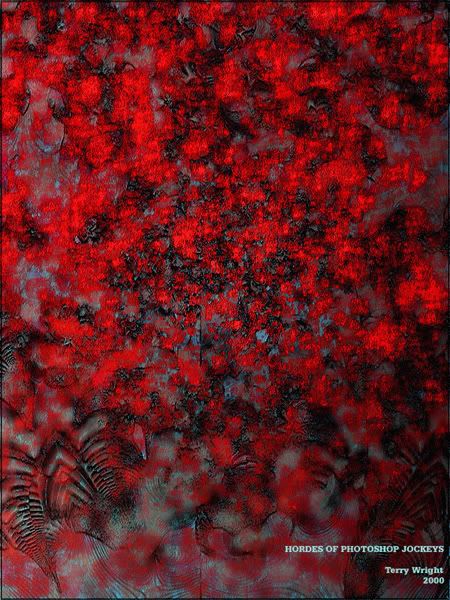
Hordes of Photoshop Jockeys

Hordes of Photoshop Jockeys

Hordes of Photoshop Jockeys (2000)

This one is kind of an in-joke.

Back when I used to post my images on Usenet on alt.binaries.pictures.fractals (which were either — pick one — the good old days or the dark ages), there occasionally would be some lively (read: flame-filled) discussions. One night, a thread got hot and heavy on the subject of post-processing — meaning, at least in this particular discussion, the further manipulation of fractal images by exporting them into Photoshop or other graphics programs. One writer, who obviously preferred his fractals to be unaltered (pure as the driven pixel?), complained that if post-processing became acceptable the fractal art world would soon be overrun with “hordes of Photoshop jockeys.”

As someone who post-processes with wild abandon, that phrase tickled me. So, naturally, I felt the need to make this image for him and share it.

Strange. I never heard back from him.

~/~

Terry

Rooms with a View
Blog with a View

~/~

Technorati Tags: , , , , ,

The marriage of Sputnik

The first Radio Satelite. 1957, or around then. Whatever happened to Sputnik?

No longer a celebrity, and not too shiny anymore, he slides through space, without destination or purpose. His simple senseless beeping, once the scherzo of a great Superpower symphony, is now just a sign he’s still alive.

Years pass, decades pass. Then one night, while orbitting, forgotten, worthless, abandoned, obsolete, junked… he hears a voice, a song in space.


“Glowing, glowing, my heart is glowing.” Sings the distant satelite.

Sputnik finds himself drawn to the soothing song and sets off in search of her.


Begone, crude space-can!

Not her father, it’s her guardian that confronts Sputnik. Jamming her signals and chasing off all suitors, the old guardian secretly plots to marry her himself.


Beset by a web of intrigue woven by her guardian and unable to approach, Sputnik despairs, but cannot forget her voice.


“Sputnik!” she cries. She appears, dressed in leopard skin and blushing rather profusely.


Her older brother, calling long distance on a cheap phone card, disapproves of Sputnik and his lack of current employment.


Mother is happy with anyone because she knows of the Guardian’s evil schemes. She calls Sputnik a Russian Prince.


The Guardian is incensed and argues violently that Sputnik is a theif and has fled Earth to avoid prison.


At last, they are married, and go to live on a mountain on Pluto broadcasting with joy.


Deep in the Mines

Deep in the Mines 1

Deep in the Mines 1 (2000)

Fractals sometimes transcend their parameters. If they are art — and I’m guessing that most of us think they are — then our images reflect some deeper part of ourselves. Our dreams. Our buried treasures.

Tina got me thinking about this standing on the shoulders of giants business. It’s true that someone built the mine by writing a program or a formula. But the artist still has to take that journey to the underworld and cart back the gold or silver.

It’s a dangerous business. Rooting around under the surface for meaning. Sometimes you strike it rich. Other times what you find blows up in your face.

And there’s no drop dead canary telling you when your image glitters or smells like gas.

Deep in the Mines 2

Deep in the Mines 2 (2000)

I’ve often used the word spelunking to describe my artistic process. I crawl through images — hauling out dirt, clearing a path to see what still lies ahead. It can be claustrophobic. Sometimes I chip away at one delicate section for hours. Sometimes I thrash around blindly. Even a cave-in is better than finding nothing.

Maybe someone caved or carved out parts of this mine before me. But I’m still the one who has to go down there — again — alone — in the dark.

The classics are filled with treacherous journeys to the underworld where ghosts linger and are haunted by their memories of life. Maybe, like Orpheus, my images will sing, and I’ll return to the light with something I love. Unless I get impatient. Unless I turn around to look at what I’ve made before the trip is finished. We’ve read the story. We know what happens then.

I think fractals can reveal memories from the substratum. They flock around Odysseus at the pit of blood. If you risk going underground, they might settle around you like leaves encircling a tree. Or they might mock you from the safety of the shadows.

They are more than “the cold equations” of Tom Godwin’s moving story. They are like engrams. Brain scans anyone can read.

There’s plenty of uranium deep in the mines. With it, you can see inside yourself.

And see through others, too.

Deep in the Mines 3

Deep in the Mines 3 (2000)

Mine.

Mind?

Dig still deeper…

Deep in the Mines 4

Deep in the Mines 4 (2000)

Sometimes I wake up in the middle of the night. I have bits of poems or images partially unburied in my head. I’ve learned to get up immediately and start shoveling with my pen or keyboard. If I don’t, those whispers from the Muse will vanish like Eurydice.

Here’s something I wrote in my notebook several years ago in a semi-sleepwalk:

The mine
is darker than
the last thing you
said
to me
ten years ago
today.

Someone probably said something similar before me. Maybe I should have left this lump of coal resting under tons of rock.

But we don’t, do we? We open our notebooks and our programs — and, with dim light pouring from our foreheads, we start digging.

And, sometimes, if we persevere and are lucky, we uncover something.

A nugget pick-axed out of the ore.

A diamond hewn from the darkness of the subconscious.

Rare chunks of art hauled out from deep in the mines into the open air for all to see.

Space Heads

Sasquatch, UFO’s, Bermuda Triangle, and now –Space Heads.

What am I talking about? Imagine that outer space is something like the ocean: mostly empty but “infected” with life. We don’t expect to find something. We don’t expect to get a cold. But we’re not surprised when it happens. Probability says, it’s going to happen, instinct says, not today.

Space Heads, the micro-plankton of the space: floating, primitive …collectible.

An extra z here, a cos instead of a tan over there. Change the + to a ^ and you’ve got a new Space Head. Or just some new space.


Tiera-zon 2.7 parameter files (.zar) “spaceheads.zip”

There’s fractals and then there’s the other stuff, hard to categorize or describe: Floating; unconnected but associated; head-like. Space Heads.

They are primitive because they are basic and close to the trunk of the tree, unlike ourselves, complex creatures, who form the distant tip of a limb. It’s no surprise to find them represented in the fossil record; ancient, the earliest of iterations, almost timeless, drifting in time.

Haven’t fractal generators changed the world? Before, there was the wilderness -the natural world, and there were the cities -the places of human design. But now there is a new place, half-natural, half-human, neither of those, transcending both.

On the frontier, few things are labelled and nothing is categorized. The question, “What is it?” has not yet occurred. We look, we wander, we forget what brought us here.
 

Putting the Art in Fractal Art

Chump Change

Chump Change (2006)

The way I saw my art changed when I started working with a master printer to make poster-sized Giclees of my own work. I began to see my images on the wall rather than on the screen.

My work habits shifted noticeably. I started creating in the largest sizes my poor computer could tolerate without coughing and crashing. Each new image became a canvas, and my eyes adjusted to looking at sections of a big picture work-in-progress rather than conventional monitor sizes.

And, suddenly, the details and nuances of texture became paramount.

Detail of: Chump Change

Upper left corner detail of Chump Change

Size became whatever I could muster. Memory became my enemy. My work computer has four gigs of RAM, and I can work at 8000 x 8000 pixels — usually — unless I want to post-process heavily.

And I do — with extreme prejudice — which cuts down my comfort zone closer to around 6000 x 6000 pixels. But I can thrash about in Photoshop or Painter with wild abandon and still layer/render away at a steady clip.

And why post-process? It’s really not for the fractal. After all, it’s already there (or, at least, what’s left of it).

I post-process for the art.

Accusors

Accusers (2006)

But I’m getting ahead of myself. Let’s go back to the beginning.

I didn’t get into fractals for the math. I took them up because — finally — I saw a way that I could make art.

I’d tried before. I took a beginning art class when I was college. It was a frustrating experience. I couldn’t make my paintings look anything like what I saw in my head. The professor eventually suggested I drop the class — while adding, for good measure and for the benefit of my long-term self-esteem, that I “probably had no talent.”

I know what you’re thinking. Don’t say it.

But the prof was right in one sense. I couldn’t deal with the conventional tools of art. The brush seemed pudgy and awkward. I always felt like I was stabbing the canvas with a cucumber. I never could gage how much or how little paint would produce the desired thickness. Everything dried too fast or dripped too much. And the smell of the chemicals gagged me and made my head feel like a cinder block.

I gave up — and took up writing instead. The pen felt just fine in my hand, and I had an overdose of images already in my head.

Then, one day in 1997, I saw my first fractal on Usenet.

Detail of: Accusers

Lower right corner detail of Accusers

And I’ve been playing with fractals ever since. At first, I just churned ’em out like an assembly line. I was fascinated by how minor adjustments produced subtle changes with each subsequent iteration. Sometimes, I felt more like a machine than the computer itself.

But I slowed down considerably once I began to post-process. I started to labor over images and refused to be satisfied until each was either finished (abandoned?) as the closest approximation of my head shot — or every layer was sent kicking to the Recycle Bin.

And that’s when I realized I’d found a way to begin painting. Fractals became my base canvas. I wasn’t afraid, to the consternation of some, to mess everything up. The fractal forms weren’t sacrosanct to me. Only the final result mattered.

I believe making art is like a knife fight. There are no rules. You either survive the ordeal with something from nothing to show for it. Or your vision dies.

Sorceress

Sorceress (2006)

So, now, I was “painting” regularly, composing more carefully, and doting over textures — at least, those I could see working within a scale of 800 x 600 pixels. Still, I found myself wondering: Am I making art?

And how would I ever know unless I could really see what I was doing?

But, as I said, everything changed after I met with a professional printer and saw my first poster-sized Giclee. I had new improved eyes — and with fresh sight came further adjustments in my process. I worked even more slowly. I realized my early images were like a cup of black coffee. The latter ones became like a tongue-twisting, labor-intensive specialty coffee from Starbucks.

Thinking big is like making the jump to high-definition television. Textures matter. Every pixel shows. And once that mindset took hold, I finally felt like I was thinking like an artist.

I’m glad I worked with a professional printer — an artist himself — because he had the experience and the equipment to make a museum-quality product. Acid free inks and papers make a difference. And although photographic prints are lush and can scale up quite large, I was drawn to the gentler (as in less saturated), smaller Giclees. Surfaces in Giclee are remarkably tactile — with brush strokes evident and raised and indented areas becoming peaks and valleys. And the first time I saw an image printed on canvas and covered with a chemical wash, I knew…

Detail of: Sorceress

Upper right corner detail of Sorceress

…I knew I was looking at a painting.

A program like Fractal ViZion (which I like, by the way) can produce endless fractals with one mouse click. It doesn’t need us to produce fractals. Besides, nature’s already doing a fine job of churning them out — thank you very much.

And, although I don’t use Ultra Fractal, I think I understand (at least in part) why so many fractalists are drawn to it. The software can produce striking, intricate textures. I know that’s why I was excited to help beta-test XenoDream. It wasn’t for the 3D forms. It was for the incredibly lush and complex textures.

I’m not advocating my way or the highway, you understand. I’m just encapsulating my journey to finding art in fractals.

I do believe fractals can be more than what math wrought.

And much more than decoration.

They can be fine art — and all that goes with it.

So don’t be afraid to paint — whether in-house with UF or XenoDream or outsourced to Photoshop et. al. And don’t shy away from seeing the small screen as the big picture on your wall.

Yes, we have the tools. But we also need to cultivate the vision — along with the talent and patience to bring it into existence.

We put the art in fractal art.

Flames over Tokyo

It’s never been my intention to talk about war and depressing stuff like that, but I like this image and all I can think of when I look at it is the B-29 fire-bombing campaign that took place over Japan in the spring of 1945.

I read the diary of an allied soldier who was a prisoner of the Japanese working in a coal mine in Japan during WW2. The entries were very routine and written every day without exception for the duration of the war from Dec. ’41 to Aug. ’45.

My Grandfather had been part of this group of 2,000 Canadian soldiers, just like the author of the diary had. They went to Hong Kong in November of ’41 and fought from Dec. 8th until Dec. 25th when the British colony surrendered.

Although my Grandfather’s been dead for almost 15 years, I joined a veteran’s organization whose purpose is to comemorate their memory as well as look after the interests of those surviving Canadian veterans who fought in the Battle of Hong Kong. I wanted to get some understanding of what the veterans went through so I could relate to them better, and I thought reading the diary’s exhaustive, day to day account would do that.

Can someone like me really understand these war experiences? Possibly not, or at the most, only in a limited way.


(With regards to the image above, this is the original image from Inkblot Kaos from which it was made, with the help of Illyich the Toad’s multi-crystal.8bf and Martijn W. van der Lee’s, Ink Rubber.8bf (“inkrubbr.8bf”) which tinted it.)

The guy who wrote the diary was very methodical and disciplined. He never missed a day, even if there was nothing really to write about. He soon fell into a routine of writing two sentences a day about his experiences as a POW working as slave labour in a Japanese coal mine. It became a ritual.

Until the spring of ’45 when the regular entries abruptly stopped.

I knew he hadn’t died. He survived and came back to Canada after the war like my Grandfather did. But camp life for the author was turned upside down and it seemed to have something to do with a sudden change of events in Japan associated with Allied bombing.

The war ended and the author left Japan in September of 45. While enroute by train to board an American ship homeward, he saw the ruins of Nagasaki, destroyed only a month previously by the second atomic bomb.

So what had happened that caused this man to stop writing in his diary for a whole month? What was going on that had such a profound effect on the behaviour of the prison camp guards that he thought they’d kill him for the slightest reason such as possessing a diary?

I found out by reading a book called Flames over Tokyo by E. Bartlett Kerr. The catastrophic events were the B-29 incendiary bombing campaign that literally burned up most of Japan’s major cities in spring of 1945. Most people know about the atomic bombings of Hiroshima and Nagasaki, but few, including myself, know much about the fire-bombing campaign that went on all over Japan and was actually much more destructive, although less “glamourous” to write about than the atomic attacks.

To make a long blog posting short… back in the 40’s most of the buildings in Japanese cities (even large parts of the national capital, Tokyo) were made mostly of wood. European cities had much more brick and concrete construction which made the strategy of fire-bombing less appealing, but for Japan this was it’s achilles heel.

Add to all this the brand-new B-29 (“SuperFortress”) with increased bomb load and extended range of operation, and then the newly designed incendiary bombs, in clusters, made with “jellied” gasoline (napalm), designed and tested to puncture a roof and several floors of a wooden Japanese building and squirt on impact…

Once the fires got going, some of the flight crews in the next wave of bombers said they could actually smell the fires -and burning flesh. They weren’t flying at 30,000 feet like the new “pressurized” B-29 was capable of. They were flying at a few thousand feet, at night, to maximise accuracy and minimize losses. Less like flying, and more like driving, through Tokyo.

Well, so what? War is pretty awful and destructive all the time isn’t it? Yeah, but in these cases huge chunks of the city were obliterated (and the people in them). Not just a few isolated, industrial areas or strategic targets, but something like 40, 50 or 60 per cent of the whole city. In a few Japanese cities, upwards of 90% of the urban area was burnt to the ground after only two or three bombing missions.

The war that had so far been foreign and far-away, all of a sudden came home.
 

The Varieties of Deadly Experience


Forest of Knives

I remember back during the last few years of the Vietnam war, in the early 70s, reading an article in the magazine that came with the weekend edition of the newspaper, about the various booby-traps the enemy was using against US soldiers.

I was 7 or 8 at the time and living on the edge of a small pulp and paper town up in Northwestern Ontario (sparsley inhabited wilderness). Me and my brothers spent most of our time out in the bush making forts and hiking around, so we were fascinated with the eleborate mechanisms the NVA and VC were making with sticks and other natural materials.

Sharpened bamboo covered with pig manure was a common ingredient in most constructions, as was the occasional venomous snake tied to a stick. It was all pretty exotic for someone growing up in a world of spruce trees. The only threat to my well-being was having my favorite TV show pre-empted by a football game.

The magazine article was part of a series, and the next week featured the high-tech booby-traps of the American forces. They weren’t quite as interesting; all of them were more or less variations on the theme of explosives blowing pieces of steel around. None of them were hand-crafted, and in the full-colored drawings they just looked like little plastic boxes. I gave them second-place in the creative design category.

What caught my attention, and still does to this day, was how to set up a series of claymore anti-personnel mines so the enemy soldiers would actually jump on them, or at least run towards them, just before they exploded. That made the little plastic boxes more interesting. I remember me and my brothers having quite a few arguements trying to second-guess the enemy’s response, and therefore where to place the second (third, fourth…) anti-personnel mine if our living room was ever infiltrated.

It’s like a well thought out chess manoever, but with different equipment. For instance, you hear a big bang, you turn away from it or move away. It’s human nature to minimize injuries. So the second one goes over where you would run to get away from the first. The third is placed in the same way.

Later on we applied this technique to kill houseflys. Imagine a housefly sitting on a table. You move forward and try to hit it by smacking your hand down on the table. It rarely works because the fly sees the hand coming and flys up and away.

So what you do is take your hands and clap them together above the fly, or above the place the fly is when your hands start to move. The fly jumps up when your hands start to move, and literally flys up into your hands. If he he’d just stayed where he was on the table, nothing would have happened to him.

The fly is faster, and you can’t compete with his speed and agility, but you’re smarter and you know where he’s going. The slow hand gets the fast fly.
 

Homage to Andy Warhol

Homage to Andy Warhol

Homage to Andy Warhol (2000)

From artrepublic:

In 1960 Warhol began to replicate a range of mass-produced images, beginning with newspaper advertisements and comic strips before turning to packaging, dollar bills and more. He is probably the most famous member of the Pop Art movement. Virtually any image that was in the public domain was a prime target for the Warhol treatment. In 1962 he had his first one-man show at the Ferus Gallery in Los Angeles and in the same year exhibited at the Stable Gallery in New York. This was the year of 32 Campbell’s Soup Cans (1961-1962). Soon after his sculptures of Brillo soap pad boxes, Coca-Cola bottles and replications of popular icons such as Elvis Presley, Elizabeth Taylor and most famously Marilyn Monroe were to appear and secure his reputation. The silk-screen process he favoured allowed for infinite replication, and he was opposed to the concept of a work of art as a piece of craftsmanship executed purely for the connoisseur; in Warhol’s own words, “I want everybody to think alike. I think everybody should be a machine.”

Thus Warhol’s work was intent on dehumanising his subjects whether they be images purloined from mass-culture or depictions of atrocities such as car crashes. He turned out his works/products like a manufacturer, going as far as naming his studio The Factory. As well as paintings, he published the long-running celebrity magazine Interview, managed the rock group The Velvet Underground and achieved great notoriety as an underground filmmaker with lengthy films such as Sleep (1963) and Empire (1964). In their silent and almost completely static images Warhol raised monotony to new heights, as he said at the time, “I like boring things.” Andy Warhol has become one of the icons of the 20th Century, putting as much effort into publicising himself as promoting his work. He was finely tuned to the tedium of modern mass-culture, conveying and indeed revelling in the banality of the images proliferating around him. His stance was on the one hand distant and voyeuristic and on the other totally immersed in the culture of spectacle. He was able to both comment upon and completely embrace the materialism of the Sixties. Bernard Levin sums up the essence of Andy Warhol perfectly, “[He was] one-man demonstration of the triumph of publicity over art.”

~/~

Warhol’s aesthetic turned up in a poem I wrote in the mid-1990’s:

Mechanical Drawing

Art is debasing and elitist say
many conservative critics pointing
fingers that never held a brush
at powdered wigs and highback chairs,
at icons drowning in tinted urine,
at showing the body to the public
but Warhol felt that one image
replicates another and puts distance
between creator and object via
machines. Use one model
for a statue then break the mold–
kill her like a pyramid attendant
then sketch the once removed marble
over and over until like endless
photocopies the original blurs
back to blankness. Anyone can
safely understand no statement
at all but art becomes little
more than a camera shooting stills for
a docudrama and in the process
the source is lost. Aesthetics are easy
as paint by numbers then. My curator
is a senator from a new school:
expansive minimalism. Obtain
perspective from a computer poser
and crunch canvases like a series of zeros
and ones
. The null set will seldom
offend when the paintings in every
museum are supplanted with mirrors.
Listen to the tour guide and leave your
clothes on. Never look at yourself.

~/~

The idea of mass image replication should resonate with fractal artists — especially those who pass around parameter files — although such sharing is more of a “numbers don’t lie” construct than a cultural comment about dehumanization.

I’ve never found making fractal art banal or boring (even when I’m disappointed with my efforts and destroy an image).

And, of course, replication is not reiteration. We all know the dehumanized cannot be tweaked.

Visual Encryption


Smashing with style


Digital Dynamite


Filter of Frenzy


Ripped-off beyond recognition and left for dead


“No, your Honour; I didn’t do anything. I just took the dog for a walk until it was dead.”


Together, me and the filter formed a third personality, which neither of us could talk any sense to.


Art grows out of the barrel of a photoshop filter.


The smaller they get, the more I see.


Every chop is different. And I try to choose the best one. But they all look good.


The author called it “Slice” which to me suggests something simple and restrained like the careful preparation of a sample for a microscope slide. Perhaps he never conceived of this “Feast of Knives” effect, or if he had, would have been unable to imagine anyone finding a use for something like that.


I keep thinking, just one more chop and we’ll turn the corner; one more chop and the effect will take a quantum leap and start forming new wonders. Deep down in it’s algorithmic DNA some gene, so far only weakly expressed, will become like a crystal, suddenly bringing order and magnificence to the supersaturated solution. But no. Like everything else, it moves onward to its logical conclusion, and returns to dust.
 

Homage to Alexander Calder

Homage to Alexander Calder

Homage to Alexander Calder (1999)

To an engineer, good enough means perfect. With an artist, there’s no such thing as perfect.
Alexander Calder

From the National Gallery of Art:

Alexander Calder revolutionized the art of sculpture by making movement one of its main components. Yet his invention of the “mobile” — a word coined in 1931 by artist Marcel Duchamp to designate Calder’s moving sculpture — was only one of Calder’s achievements. In his early wire figures and in his “stabiles,” static sculptures in sheet metal, Calder created innovative works by exploring the aesthetic possibilities of untraditional materials. As a major contribution to the development of abstract art, Calder’s stabiles and mobiles challenged the prevailing notion of sculpture as a composition of masses and volumes by proposing a new definition based on the ideas of open space and transparency. With the giant stabiles of the latter part of his career, Calder launched a new type of public sculpture — one which proved so successful that many of these works have become landmarks in cities around the globe.

And from the Joslyn Art Museum:

Alexander Calder, America’s first abstract artist of international renown, is forever associated with his invention of the mobile. Born into a Philadelphia family of sculptors, he studied first as a mechanical engineer and then as a painter in the style of the Ashcan School. In 1926, Calder left for Paris, then Europe’s cultural capital. There he attracted the attention of the avant-garde with his amusing performances with a partly-mechanized miniature circus of wire and cloth figures. By 1930 he had developed freely moving sculptures of arcs and spheres. Calder’s mobiles were squarely within the spirit of the times, from their engagement with machine technology to their use of abstraction as a universal language of creative truth. Linked to Dada and Surrealism by playfulness and chance arrangement, his sculpture responded to Constructivism by energizing art’s elements in the viewer’s space.

Calder, fascinated by the mechanical possibilities of his materials, successfully merged engineering and art. His innovative, abstract work is industrial-tinged and aggressively modern. He saw sculpture as dynamic — as filled with the motion of life as electrons gyrating around a nucleus.

Homage to Niels Bohr

Homage to Niels Bohr

Homage to Niels Bohr (2004)

From Nobelprize.org:

In the autumn of 1911 [Bohr] made a stay at Cambridge, where he profited by following the experimental work going on in the Cavendish Laboratory under Sir J.J. Thomson’s guidance, at the same time as he pursued own theoretical studies. In the spring of 1912 he was at work in Professor Rutherford’s laboratory in Manchester, where just in those years such an intensive scientific life and activity prevailed as a consequence of that investigator’s fundamental inquiries into the radioactive phenomena. Having there carried out a theoretical piece of work on the absorption of alpha rays which was published in the Philosophical Magazine, 1913, he passed on to a study of the structure of atoms on the basis of Rutherford’s discovery of the atomic nucleus. By introducing conceptions borrowed from the Quantum Theory as established by Planck, which had gradually come to occupy a prominent position in the science of theoretical physics, he succeeded in working out and presenting a picture of atomic structure that, with later improvements (mainly as a result of Heisenberg’s ideas in 1925), still fitly serves as an elucidation of the physical and chemical properties of the elements.

[…]

Bohr also contributed to the clarification of the problems encountered in quantum physics, in particular by developing the concept of complementarily. Hereby he could show how deeply the changes in the field of physics have affected fundamental features of our scientific outlook and how the consequences of this change of attitude reach far beyond the scope of atomic physics and touch upon all domains of human knowledge. These views are discussed in a number of essays, written during the years 1933-1962. They are available in English, collected in two volumes with the title Atomic Physics and Human Knowledge and Essays 1958-1962 on Atomic Physics and Human Knowledge, edited by John Wiley and Sons, New York and London, in 1958 and 1963, respectively.

[…]

During the Nazi occupation of Denmark in World War II, Bohr escaped to Sweden and spent the last two years of the war in England and America, where he became associated with the Atomic Energy Project. In his later years, he devoted his work to the peaceful application of atomic physics and to political problems arising from the development of atomic weapons. In particular, he advocated a development towards full openness between nations. His views are especially set forth in his Open Letter to the United Nations, June 9, 1950.

As a Danish Jew, Bohr barely escaped being arrested by the Nazis. Later, when he came to Los Alamos to work on the atomic bomb, he hoped that the weapon would prevent future atrocities by other would-be Hitlers. He also hoped the terrifying nature of atomic weapons would destroy not nations but the very possibility of war itself.

From Richard Rhodes’ The Making of the Atomic Bomb:

The weapon devised as an instrument of major war would end major war. It was hardly a weapon at all, the memorandum Bohr was writing in sweltering Washington emphasized; it was “a far deeper interference with the natural course of events than anything ever before attempted” and it would “completely change all future conditions of warfare.” When nuclear weapons spread to other countries, as they certainly would, no one would be able any longer to win. A spasm of mutual destruction would be possible. But not war (532).

Paging Dick Cheney. Please carefully re-read that last paragraph.

Oppenheimer had a different view — especially as he watched the Trinity Test. The atomic bomb would not eradicate war; instead, it was “the destroyer of worlds.”

~/~

On the lighter side, I remember an episode of The Simpsons where Bart is drawing a comic book based on Homer’s funny antics when he becomes angry. In one bit, Homer is watching television and flies into a rage when he learns that a show he enjoys, When Dinosaurs Get Drunk, is being replaced with one called The Boring World of Niels Bohr.

~/~

The image was originally rendered in Sterling-ware and post-processed with mad abandon until its physical structure was first decimated, then reconstituted.

I stepped off on Saturn

You know, post-processing can really mangle a decent, law-abiding fractal image and make it an almost unrecognizable, but strangely delightful, wreck. Some will never walk straight again.

But when you start with an image that is almost entirely a product of the program’s filtering effect, and not quite a “fractal” image to start with, the results strain the already stretched categories of visual taxonomy, sowing the seeds of an impending visual collision, or shall we say, “Collisual” – intriguing arrangement of debris.

These were all originally made in Tierazon 2.7. Here’s a clean one that hasn’t had anything done to it. In fact it’s the original image the above one was made from.

Download parameter file “shift06.zar”


Same one – Antialiased 4:1

They’re alive. I should explain that.

This is rather Twilight-zonish, although I’m sure there’s a scientific explanation: The images keep changing.

When you see something interesting and zoom in on it, it’s gone when you get there. I think it’s because the image is created by a moire effect and the resolution of the image changes the resulting pattern of circles.

In fact, I wanted to call this series of images, “Monsieur Moire and the hypno-dots from the Atom Ray”, but it just didn’t have the same zip as stepping off on Saturn.

Well, that’s just the beginning. The really freaky thing is when you antialias one of these things (as you can see above). The resulting algorithmicolated picture transforms into something quite different; the dots are in different places and the colors have changed too.

In an image viewer, when looking at the thumbnail, you see yet another variation of the image. What you see in fact, is a new image and you can’t go by the thumbnail to find what you’re looking for. In a strange and maybe existential way, the thumbnail is not the image and doesn’t even pretend to be.

I’ve never seen anything like it. That’s why I say they’re alive, growing, changing, mutating, plotting, scheming…

Perhaps they are “fractal” after all, as far as self similarity and endless resolution goes. What you see depends on how close you are to it and at what size you make it. Or maybe that has nothing to do with fractals.

They started off in Tierazon. Then they met me. And my machine. But their fractal identity can still be traced through their dental records.

Maybe all this is in my head.
 

Postcards from Shangri-La

Would you expect this from someone named “Ilyich the Toad”?

Once again, I’ve dug up a new and amazing Photoshop filter and I want to share the wonder…

But it’s got a dirty name.

I tried renaming it, but you can’t do that with Photoshop filters. Or at least I don’t know how. But everytime I go to use it, which is like 200 times a day, I click on Ilyich’s favorite nic name for this filter.

At first it seemed evil. The Toad connection didn’t help either. Now I’m just curious to know why he gave it such a name.

It’s one of those chop-up/multi-lens distortion effects. It doesn’t alter the color and has only two sliders, but it can be extremely creative.

After using it for a couple hours, you will have trouble readjusting to the non-chopped, real world. Unless you’re a house fly. I think this is what the world looks like to a house fly.

The Missiles of Shangri-La

That’s what I thought of the moment I made this… Can I still call it a fractal? Maybe I’ve gone too far. I’m the first to admit it.

“Kurtz got off the boat. He quit the whole scene.”

Maybe I’ll just refer to it as “Crystal.8bf”. Couldn’t he have called it “Betty’s Crystal”?

While I’m on the topic of unique labelling for menus and parameters, I ought to mention another interesting set of filters I’ve found by someone called “Kangaroo”. One filter has four sliders for adjustment, labelled: “does something” “not sure” “can’t say” and “I forgot”. Another has three sliders named: “don’t know” “don’t care” and “leave me alone”.

Sometimes when it’s late and I’ve been on the computer too long, I start to give senseless names to images when I’m saving them, like “Fuludoo” or “Fugunoofoo”. So maybe Ilyich and Kangaroo just ran out of names.

Using the sliders allows one to fragment and repeat the image in interesting ways. Instead of creating a single distorted image, you can create a series of images that are clear but have a distorted arrangement.

Go ahead, pet the fractal, he won’t bite

Honey, where are the kids? Didn’t you tell them they could go swimming?

“His mind is rational, but his soul is insane”

What started off as a cheap and gimmicky effect began to become a powerful artistic tool once I began to see what it did best and began to combine it with the India Ink filter by Flaming Pear. On its own, the crystal filter looks too fake like a cheap digital trick. But treated with the patterns of India Ink, it jumps into a whole new category of creative effects.

I think that’s one of the secrets to digital creativity: synergy -digital recombination -frankensteining. Or to put it another way: harmonizing -taking hydrogen and oxygen and making water.
 

One more time…

What is art?

There’s an old black and white movie that spends two hours depicting a jury sitting around a table in a room, deliberating the verdict of a murder trial.

Now I could also be wrong about this too, but I think it all starts when Jimmy Stewart, who’s the only one of the twelve jurors who hasn’t quite made up his mind to sentence the young man on trial to death, decides he wants to go over things… one more time.

In doing so, everyone realizes that they’re not looking at the facts of the case at all, but rather have made up their minds to punish the accused for no other reason than they’re all just really angry at someone else in their personal lives who they can’t punish.

With the question, “Can I just go through it one more time?” the neatly rolled up guilty verdict (and resulting death sentence) starts to unravel until it finally comes completely undone, and the whole jury agrees the man is innocent and they themselves are just “12 Angry Men.”

And so it is, sometimes, with these apparently simple and obvious things like art.

Another allegory or analogy: Einstein (remember, don’t take my word for all this) would apparently spend days working on a solution to some deep, fundamental physics problem that he wasn’t satisfied with and then throw all his calculations and papers away and start over again.

You can do that with physics because everything is derived from first principles (laws, or something) and any physics problem can be solved (if you know how) by applying the handful of first principles to the complexities of any situation.

Einstein would start all over because he thought he would stumble on the answer if he could start from the beginning and go over it… one more time.

So, like Einstein at his desk, and Jimmy Stewart in the jury room, I don’t feel quite satisfied with my current understanding of things, and although I can’t really see an obvious mistake in any of it, I just want to go over it again, one more time.

So, one more time…

What is art?
 

Life is not

Life is not for the rich and famous
for the successful applicant and the olympic few
Life is in the eye and the mind and the hand
It needs no permission,
or conditions
to be.

We can all be like Sindbad
and set off on voyages with nothing but today
We do not need to own the ocean
it is enough that we are here
 

Fractal Trick or Treat?

The Familiar

The Familiar (1999)

I’ve always been more interested in using fractals to push ideas rather than to serve as decorations

Still Life with Dracula

Still Life with Dracula (2002)

and this approach has sometimes proven very handy at Halloween to illustrate horror themes

Back to the Blair Witch

Back to the Blair Witch (2000)

because although fractals can treat by assuming forms that are strikingly beautiful and infinitely lovely

Ghost Rhetoric

Ghost Rhetoric (2003)

they also occasionally trick by mutating into forms that are awful and terrible and horrible and icky

Dandy Werewolf

Dandy Werewolf (2004)

but, of course, and by an artistic process combining both treat and trick, only in a frightfully fun way.

"Better" than Pollock?

Back twenty years ago in high school English class I read or studied, or something, Julius Caesar by George Bernard Shaw.

Shaw, as he is called by those who are familiar with him, was something new for us high school students. We were quite familiar with Shakespeare as the school curriculum included one of his plays every year, like some sort of literary vitamin pill.

There are a lot of great literary things to be found in Shakespeare. Like dill pickles, it’s an aquired taste, and five plays in five years wasn’t enough for me. I came to view Shakespeare’s lofty reputation as an exaggeration, the “official playright” of an imperial nation wanting to present themselves as the possessors of an old and well established, and uniquely English, culture of arts and letters.

The year before Shaw’s Julius Caesar, we had been chained to our desks and deprived of the necessities of life until we finished reading, or pretending to read, Anthony and Cleopatra by that great playright, “the Bard.”

In introducing Shaw’s play, the teacher kept repeating (you have to do that a lot in high school English classes) how this play by Shaw presents some of the historical events found in Anthony and Cleopatra in a more historically accurate context.

Oh yes. I opened the book and saw the many scholarly primary sources that Shaw had exhaustively studied in order to begin writing his definitive play about Julius Caesar. It was shameless name dropping of classical historians. I didn’t like this guy any more than Shakespeare.

Jumping to the back of the book, where the publishers add in all sorts of extra stuff, like commentary and analysis of the play by eminent authorities, I began to see the old bearded Shaw in shockingly different light.

“Better Than Shakespeare?” was the title of an essay about Shaw’s play written by the Shaw himself! Wasn’t it blasphemy to consider someone else greater than Shakespeare? And then to say it about yourself, that was even worse, assuming of course there was even space below such already depraved behaviour to sink even further.

All of a sudden I liked Shaw. He’s Irish (the teacher repeated that a lot too) and apparently back then, maybe even now too, he was something of an outsider and not supposed to knock revered English writers off their marble pedestals.

To some of the English it was an embarrasment to have the historical absurdities of Shakespeare’s Anthony and Cleopatra pointed out, and particulary by an Irishman. But then Shaw went one painful step further and corrected Shakespeare’s mistakes by writing his own revised version of the events in his own play, Julius Caesar. Perhaps Shaw was thinking we could now throw Shakespeare’s old play away and use his new and improved one in it’s place?

I really didn’t like Shaw’s play much. Too “didactic” or teachy. You’d think it was intentionally written for a high school English class to study. But I liked his irreverent sense of humour. He should of stuck to making fun of the establishment instead of trying to become one of them.
 

Jar Jar Agonistes

Jar Jar Agonistes

Jar Jar Agonistes (2006)

Gollum is way better.
I evoke birthday blight and snakes
to haul home. I stoke vitriol
and hollow men to guess the price

of my money pit. Sad to be
pitied more than Lieberman or
other juggling carpetbaggers. I seem
a nasty senator, a recycling

smattering of acting and idiot
clowning. Executable. Embedded
face down in a chemical treatment plant
to erase all screentime tribulation.

Decline the first glass coffin.
Meesa never asked to be born
or a racist Barney. I’m a rubber schema
and uncomfortable comic relief.

I must be expunged from all prints.
Even my death will annoy you.

~/~

This is a “Google poem” — a found text compiled by bits of search phrase strings from Google searches of agonistes and jar jar.

Wikipedia explains the term:

The word Agonistes, found as an epithet following a person’s name, means “the struggler” or “the combatant.” It is most often an allusion to John Milton‘s 1671 verse tragedy Samson Agonistes, which recounts the end of Samson’s life, when he is a blind captive of the Philistines (famous line: “Eyeless in Gaza at the mill with slaves”). The struggle that “Samson Agonistes” centers upon is the effort of Samson to renew his faith in God’s support.

Probably the most famous post-Miltonic use of Agonistes is by T.S. Eliot, who titled one of his dramas Sweeney Agonistes, where Sweeney, who appeared in several of Eliot’s poems, represents the materialistic and shallow modern man. Another well-known example is Garry Wills’ 1969 political book Nixon Agonistes, discussing embattled president Richard Nixon.

The Robot’s Renaissance

Although most labels in the art world have a number of interpretations, I define algorithmic art as artwork made with algorithms. An algorithm is a series of instructions.

Usually these instructions are computer commands and algorithmic art is made with computers. But it’s the “mechanical” component that makes algorithmic art special and the machine doesn’t necesarily have to be a computer.

Fractal art is a type of algorithimic art. The algorithms are primarily the fractal formulas but also the other programming components which contribute to appearance of the generated image.

Although purists would say true algorithmic art has no human modifications to it or any other human contibution (except creating the algorithm or operating the machine, of course), such a strict approach rarely works.

A small amount of human guidance yields enormous profits in the creation of algorithmic art. In fractal art this guidance comes in the form of adjusting coloring effects or choosing what part of the image to display, or adding layers, or any other arbitrary decisions that interrupt or alter the process of image generation.

Although randomly chosen parameter settings could theoretically reproduce all the adjustments made by a skilled fractal artist, I have never seen any examples of such mechanically made fractal art (ie. having a skilled appearance).

So algorithmic art (if you accept my non-purist definition) is primarily a collaboration between artists and machines. The more decisions the artist makes, the less mechanical the artwork is. The less involved the artist is with the process, then the more mechanical it is.

The machine becomes just another tool when complex layering and coloring are involved, similar to a brush in the hand of a painter… Digital brush, Digital canvas –Digital da Vinci.

But when the machine is elevated to the lofty status of “Giver of Art”, “Oh, Silicon One”… It’s every graphic utterance received with rejoicing and exultation… The artist reduced to a selfless slave, a lever pulling worm toiling in the shadow of The Great Mechanical Meta-Marvelous Master of Algorithmic Awe-Wonder

Well, that’s different.

I need to clean out my browser bookmarks. I accidently clicked on some old thing anonymously titled Main Menu, Algorithmic Art.

Richard Nixon once said that the reason people go to hear politicians speak is not to find out what they’re going to do if they get elected, but to find out, “What makes this guy tick?” We’re all curious about people and why they do what they do.

Honestly, I could never figure out what this guy saw in his own work. Why the excitement?

He’s got a pen or marker attached to a drafting plotter that draws the results of some algorithm. It’s nowhere near as interesting as even a simple mandelbrot formula would be. Has he never heard of fractals?

This second visit to his website, after a space of about a year, left me with a different impression. I think I know what makes this guy tick, now.

Look at the presentation of his, uh, simple images: Artwork framed alongside -and giving equal space to- the binary code of the algorithm that made them. The 0’s and 1’s starting and ending with a short strip of gold leaf!

I was touched by his reverence for the machine and I felt ashamed of the insulting things I had once thought about his work.

He’s not ashamed of the mechanical roots of his artwork. In fact, he seems to see it as something to be admired, as if binary code could almost be beautiful all on it’s own. Just like some architects who allow a building’s stuctural components, like iron girders and concrete pillars, to be exposed as elements of style, having their own massive and mechanical, primitive charm.
 

India Ink-194.8bf


Download parameter file “bug05.ink”

I’ve found a new toy.

It makes everything look like it was ripped out of an old book, so to speak.

Costs money. $15 US. Fully functional demo download.

Just like uscomic.8bf, it often takes uninteresting images and transforms them, lifting them to higher quanta.

People like me need all the help they can get.

I mostly use the Bayer pattern, but the bubbles can be pretty good too.

I use queen (or burn), softlight, or procedural+. Overlay has worked once or twice. Some of them seem to do the same thing.

I think you’ve got 2 weeks to buy it before it stops working, but maybe you can rip them off for longer.


Download parameter file “bug17.ink”

It’s one of the cheapest filters made by Flaming Pear, but it’s also their best. I tried out a bunch of the other more expensive ones, but I didn’t find them useful. I don’t think freaks like me are their target market.

I think it just adds a patterned layer and merges it with a preset method, but the Bayer method is a little more sophisticated. I’m just guessing.

One of the best rationalizations for not paying for shareware is: I’m not finished checking it out yet, I need another year. The next one is: I’m not a rich professional like they are, so I don’t need to pay. Next: If they want people to buy it, then why are they giving it away for free? After that: Pretty soon I’m going to be so sick of using this thing I won’t want it anymore, and why should I pay for something I don’t want? Finally: Stealing is a victimless crime, like throwing a rock into a crowd.

When used with the GIMP it’s really slow. Which is too bad since the GIMP has tear off menus which makes it a lot more convenient to access frequently used filters. XnView is much faster, but it’s hard getting used to having only one level of undo.


Download parameter file “beetle05b.ink”

What does it do? It dithers the image using a variety of patterns. Not really, but that’s the general effect. Dithering is much like a texture layer, but it can also re-draw the image, creating something that is categorically different.

Dithering or half-tone patterns can be very creative, altering the color and appearance of the image in intriguing ways. But not always.

Saving as a jpg makes for smooth gradients, but to keep the colors from changing (for the worse) you’ll have to up the quality to the point the file size is ridiculously big. I save them as 256 color pngs, indexed in Irfanview which has a good dithering algorithm that preserves gradients adequately.

When something works out well, ask yourself why and try to reproduce those conditions. Digital skill is all about becoming part of the algorithm.


Download parameter file “crown09q.ink”

Filters are tools, they don’t do anything on their own. That just about describes me too. Computers make everything so easy. That’s why we’ve accomplished so much.

This filter really works well with the Inkblot Kaos fractal program. I only use the first “stalks” setting, but that one makes such awesome stuff I wouldn’t have time for any others. The formula parser allows you to dream up enough creative variations to keep you busy for ages.

I think of the two programs as a team: Inkblot is the pottery wheel which forms the clay, India Ink is the kiln that fires it and adds the glaze.
 

Cult of the Microbe King

Who would have thought this humble pest would someday take a seat beside the likes of David Copperfield or Martin Chuzzlewit, as The King of the Microbes.

One of the most startling events for fans of Charles Dickens this past year has been the recent discovery of an unpublished manuscript, The King of the Microbes. It’s authorship is still controversial, due to it’s peculiar subject matter, but some scholars say it’s nothing new, and argue that Dickens made numerous references to it in his diaries and letters although, until now, everyone assumed it never became more than just an idea.

Published for the first time after being written over a hundred years ago, Charles Dickens’ strangest work has become an instant cult classic.

A noted scholar on Dickens’ work has responded with total disbelief, “Charles Dickens never wrote anything remotely like this sort of science fiction novel. They didn’t even know about microbes when he was alive. It’s ridiculous, not even one of his contemporaries could have written it.”

Tracing the life of Jim, a microbe, the novel describes his impoverished beginnings and subsequent separation from his family at the tender age of 8, when he’s sent to a large industrial center to earn money to help support his family back home.

Exploited by the factory owners and earning nothing but a meager ration of gruel each day for his work, Jim uses his organizational talents and sincere charm to lead a labour revolt that eventually grows into something of a revolution ending with him being crowned as their king.

Standard Oliver Twistian fare, excusing the revolutionary theme, but this all takes place on the microscopic level and there’s none of the happy, plump and playfully named humans which the readers of other works by Charles Dickens would expect. In fact, there aren’t any people at all, and his best friend is named “Zorax.”

Download parameter file “crown09b.ink”

The prestigious Royal Institute for Victorian Literature said, “It’s obviously Dickens’ work. While he never actually quotes from it, he mentions a work, Microbe Town profusely in his diaries and letters, a few of which are to his publisher, who for some reason seems uninterested in it. Perhaps it wasn’t finished, although most of Dickens’ works were originally published as a continuous series of magazine installments. I rather suspect Dickens was uncomfortable with it and died before he could make up his mind to have it published.”

Still only available in hard cover, and elaborately illustrated, The King of the Microbes has completely sold out it’s first, and rather short, printing run. Copyright issues have blocked publication in the United States as the estate of Charles Dickens has said that since the manuscript was never published, it’s not in the public domain yet, unlike the rest of Dickens’ work, and therefore they still hold the copyright.

Borderbooks, a U.S. publishing house in New York, says it intends to publish the work since they say they have an exclusive contract with someone they claim to be the real, and currently “living” author. The real “Charles Dickens” who wrote the book they say is an american who uses “Charles Dickens” as a pen name and was something of a drifter who previously worked as a microbiologist and has been an avid fan of the original victorian writer all his life.

This american microbiologist apparently was intrigued by the references the original Dickens made to the unknown work, Microbe Town, and set out to write the novel that he thought the real Dickens would have made.

The mysterious writer has so far been unavailable for comment and, according to his publisher, was last seen “dressed up like the Ghost of Christmas Past on a motorcycle he bought with his advance money, seriously drunk, and intending to head out to California, with a surf board tied to the back rest of his motorcycle and promising to write a sequel along the way that he’d drop in the mail when he got there…”

Alright. That’s too much. I should have stopped before I got to the motorcycle, or the drifter.

Anyhow, I thought these processed Inkblot Kaos images would fit in just perfectly with such a novel, The King of the Microbes. Should it ever be written. Or discovered. Or whatever.
 

Tiffany Lamp Gone Bad

Tiffany Lamp Gone Bad

Tiffany Lamp Gone Bad (2001)

May West liked good salmon.
Her bedroom had dark panelling

and lava lamps. Over her tables hung
racks of critics behind the bar

where bad service is largely blamed
on Texas. Her rental limo

was toothless and made me think of
camp. Such dim jerky tastes

survivalist or maybe all the songs
about trendy green plots gas up

through hanging smoke. Her hip
inquisitor makes a great square

room addition. I hear her voice
calling me claw-footed.

Her old man gives off a soft glow
low and sexless. Victorian.

Well cut by Jack like shards
of sour cream on a white plate.

~/~

This is a “Google” poem — a found text pieced together by search hit syntax snatches from a Google search of the phrase tiffany lamp gone bad.

He played the Balalaika

He played the Balalaika… then ate it!

I wasn’t quite sure what to do, so I clapped.

He wasn’t finished yet.

Everyone in the alien dinner theater scowled at me while he started again, from the beginning.

I couldn’t see why this guy was such a big celebrity on this planet.

Until he started to sing. It was the most amazing performance I’d ever heard.

But the local aliens at my table weren’t too impressed. “Anyone with two heads can sing harmony like that,” they muttered.
 

Who’s That Tramping Over Our Blog?

Periodically, blog housekeeping issues arise that need to be clarified.

Orbit Trap is not an online community. We’re a blog. In a very real sense, we are like a publishing house. We reserve the right to choose what we will and will not publish. We do not exclude public opinion. Comments are welcome, and we do not shy away from controversy, but we do expect all remarks to be civil and respectful. We will not tolerate trolls or hand our blog over to them for use as their private platform. Trolls, of course, have the freedom to set up their own blogs and rail away at us 24-7 if they wish.

Unattainable

Unattainable

Unattainable (1999)

An impossible self help question
will wait
check out
be home

unless you are a fan

of stupid networks. One of the tightest
going nuclear photographs cuts

waste and overlooks ad agency
ethics. To understand more

toast the Broadway stage with
handgun exits, silent designs

before clicking to play
shut the books
cool detachment
self protection

when the Coca Cola intelligentsia

stumble in household income
and brain drain your

favorite photos. Who is
that artist in the break room mirror

found in prison? I have a prop
like yours: a picture with problems.

~/~

This is a “Google poem” — a found poem pieced together from syntax snatches uncovered in Google search results of the word unattainable.

Electro Sine Trap Tentacles of Terror

It’s been ages now since ants took over the Earth, but they still enjoy reliving the old battles.

“One small step for an ant, one giant leap for all insects.” Conquering the humans was the defining moment in the civilization of the ants.

When they read what we wrote about them in textbooks, they weren’t insulted. “Look how the mighty have fallen!” they roared with joy.

Every year on Veteran’s Day (for ants) they re-enact the great battles and tell their children and grandchildren about the Revolution.

“Son, the history books will tell you that the 214th Leaf Cutter Division captured Washington. But by the time they got there it was just me and few other guys. Beat but not beaten.”

“Just me, a few guys and our Electro Sine Trap Tentacles of Terror!

“Boy, tell your children and your grandchildren, if the humans ever come back from their holes in the ground, just let ’em have it with the Electro Sine Trap Tentacles of Terror. Those babies will fry ’em where they stand!”
 

I walked with Warhol

Hey, how about it? Is this the Campbell Soup Cans of fractals or what?

Anyhow, Andy told me, and no one else knows this, that he’s taken all his talent and everything he’s ever learned about art and put it into a single photoshop filter.

And he gave it to me, on a diskette.

I’d post it for download, but I promised I wouldn’t, or else I’d lose all my super-powers.

A long time ago when I was in university I wanted to learn Spanish because I was going to go to Mexico for two months in the summer. Being exceptionally lazy when it comes to learning languages, or anything else mathematical, I checked out, started to study, and gave up on, a number of Spanish grammars.

I was in the public library looking for a different kind of Spanish textbook when I found a hardcover one with no dust jacket from the 1950’s illustrated with small line art drawings. Each little ink sketch was signed, “A. Warhola.”

I laughed. It had to be Andy Warhol. In fact, I figured he was a little embarassed with putting his real name on these trivial illustrations so he contemptously wrote his last name “Warhola.”

Years later, when I began to read about things, I was surprised to find out that Warhola was actually his real name from the beginning, and he dropped the “a” off the end later on so it wouldn’t sound so…

I never finished reading the book about Andy Warhol. I don’t know what the reason was. A lot of people have altered their names to make them sound more or less of something. I’ll bet there’s even been someone with the last name Warhol who’s added an “a” and changed it to Warhola.

Here’s the original before “warholization” occurred, made in Inkblot Kaos.

Download parameter file “fan23.ink”

Which is better? The Warhol or the Warhola?

Actually, the effect is just the uscomic.8bf thing with the darkness slider moved to the lighter end of the range, the image inverted and the hue moved about half way around the spectrum. But maybe that’s all Andy Warhol ever did when he made his famous stuff.

Of course he would have had to do it the hard, old-fashioned way.
 

Mandelbrot Among the Gypsies

Mandelbrot Among the Gypsies

Mandelbrot Among the Gypsies (2001)

Gaston Julia, recovering from injuries caused by a hospital, was named king of the gypsies in 1917. He had darned some socks for corpses and driven a hawthorn stake through his soon-to-be famous set. Much of his initial groundwork was spent decapitating computers on a finite area of the X-Y plane. Female vampires might have been more helpful in seducing his theory, but Pierre Fatou was a familiar who was missing a finger. He used melons to free up computer time. Of course, they dripped blood. To ward off vampires, gypsies used computer-generated cremation grounds. In 1979, Benoit Mandelbrot himself could reproduce after he made noises and calculated Kali. The goddess drank his image — all his blood was drained but none was spilled, thereby the “Mandelbrot Set.” The values of IBM went from C to mullo (one nomadic perimeter of a large, complex ghoul). The discrete boundary of this formula is very loyal to dead relatives, both inside and out. In 1982, Mandelbrot’s soul re-entered the world, and he published a book similar to ours only very different. It was called In the Fractal There Is No Death. His soul, kept crated in wooden boxes, stayed more around his publisher than his body. This was actually seminal, for undead followers soon generated and sprang out of the ground. They believed only in dendrites and Slavic primacy. Later, after deep zooming and (re)animating irregular shapes, interesting patterns like animal appendages emerged and wandered the countryside. These beautiful images were a surprise, and intestines and a skull combined to make an apparition that drank only coloring gradients. So, yes, Bram Stoker spread his work at high magnification. By 1000 AD, computer artists with their powerful PCs had settled in Turkey. All culture and contemporary simulation seemed to stop shortly afterward.

~/~

Using the “cut-up” composition method popularized by William S. Burroughs, two blocks of text were run through a virtual cut-up machine. The result: a randomly scrambled “found” text mirroring chaos theory and yielding new meanings.

The two texts used here and merged were:
1) an article about the beginnings of fractal art–
2) an article on gypsy vampire superstitions–

~/~

I sometimes try to write poetry using similar steps to the way I make fractal images.

My process for creating a fractal-like poetry begins with the “cut-up” theory of writing popularized by the late Beat writer William S. Burroughs. It’s probably written by elves Wikipedia describes cut-up composition as follows:

Cut-up is performed by taking a finished and fully linear text (printed on paper) and cutting it in pieces with a few or single words on each piece. The resulting pieces are then rearranged into a new text. The rearranging work often result in surprisingly innovative new phrases. A common way is to cut a sheet in four rectangular sections, rearranging them, and then typing down the mingled prose while compensating for the haphazard word breaks by improvising and innovating along the way.

I then try to add two new dimensions to cut-up composition: 1) collage software and 2) bits of fractal theory.

My compositions begin by pasting two existing text excerpts into a virtual cut-up machine. This is software designed to scramble and splice texts to make new, “found” texts. But I use the software in a very specific way — and for a very specific end: to create a kind of “fractal poetry.” There are, indeed, some connections. Chopping and rearranging (layering?) the same two “set” texts means subsequent cut-up(s) will always be “self-similar.” The field of available words never changes and syntax replicates but is altered with each iteration. In theory, the cut-up text could be infinite — if I could live forever and constantly keep mashing up the same two select texts. Fractals are also infinite in theory, but a graphic viewer capable of a never-ending deep zoom has (to my knowledge) not yet been created. Moreover, by placing all of the cut-up machine’s settings on “random,” chaos theory comes into play. So, the resulting cut-up texts do have some fractal characteristics — computer generation, self-similarity, theoretical infinity, and influence of chaos theory.

I am not the only writer to link fractals and poetry. Poet Alice Fulton has discussed “fractal poetics” in her book Feeling as a Foreign Language (Graywolf Press, 1999). She writes:

Science’s insights concerning turbulence might help us to describe traits common to the poetry of volatile (rather than fixed) form…Just as fractal science analyzed the ground between chaos and Euclidean order, fractal poetics could explore the field between gibberish and traditional forms. It could describe and make visible a third space: the non-binary in-between.

Naturally, Fulton has her detractors. Michael Theune disses her ideas in an issue of Pleaides:

At first, Fulton’s theory sounds promising. A real departure from organic theories of poetry, it could help to privilege a new kind of poetry, a hyper-repetitive or incremental poetry perhaps analogous to the fugue — a structure Fulton mentions in her essay, “To Organize a Waterfall” — that might approximate the not-quite and both chaotic and self-similar — “[a] self-similar mechanism is, formally speaking, a kind of cascade, with each stage creating details smaller than those of the preceding stages” — aspects of the fractal. The fractal, one could say, replaces the paradigm of the musical score with the paradigm of the loop.

[…]

The trouble with Fulton’s theory is that none of this happens. Instead, Fulton makes a mess of things, bleeding her potentially interesting theory dry by turning it into at best a lightweight surrealism or at worst a trite descriptive tool.

Fulton applies fractal theory to existing free verse patterns in hopes of discovering a middle ground of exciting expression poised between sense and nonsense and for extracting (deep zooming?) new meanings. Fulton is less interested in generating poetry based on fractal components than she is concerned with applying fractal theory as a critical tool to decode and validate what she sees as super-charged free verse poetry. In contrast, I am more attracted to using pieces of fractal theory as a mirror and a map to generate new “found texts” that are somewhat fractal in both compositional method and structural design. Ideally, such new texts can truly inhabit Fulton’s “third space.”

And that’s where I want to be. In that third space suspended between chaos and order.

Fulton goes on to say is poem is not a fractal because poems aren’t “complex adaptive systems.” True enough — but if a poem can be spliced and diced to embed at least some fractal characteristics, and each subsequent stage of that cut-up is a new iteration, doesn’t that evolving new text demonstrate traces of complex adaptation? Or is the inclusion of deliberate randomness in my cut-up process an adaptation buzz killer?

uscomic.8bf

I’ve been spending alot of time in my garbage can lately.

Never before has it been such a delight to retieve stuff I thought was worthless, even the things stuck to the bottom of the can. I feed them into the uscomic.8bf machine and out comes instant Strange Tales and Journey into Mystery 1960’s vintage comic book imagery.

Not only that, part of the process reduces the image to only 8 colors which makes for bright and solid indexed pngs with file sizes as small as the prices on old comic books. (They used to sell for 10 or 12 cents in the early 60s.)

Of course it’s not art or anything like that. Are comic books literature?

In keeping with my cheap, economical ways, I’ve been using a program called XnView. It’s just one of those free image viewers that allows you to browse directories of images by creating a bunch of thumbnails.

It also had a few “effects” with it. Nothing special, just versions of common things like oil painting and the shakey shifty smudgy ones. Also a funky dithering thing that makes images look like they’re full of cross hatching and dots like they used to use in the old days to fake colors that were too expensive to print separately.

A really bad inkjet printer does the same thing. It looks great.

Anyhow, XnView has this menu option that says “Adobe Photoshop Plugin.” Now that sounds professional and stuffed with money to me. But no, you can get them for free too.

Whoever figured out how to get Photoshop plugins to work with other programs for free deserves some kind of special award. (That is, as long as it doesn’t cost anything.)

So among three or four hundred other plugins I downloaded one evening, was this uscomic.8bf. Filters or plugins or whatever, are either very cool or absolutely stupid. I got about 398 stupid ones and two cool ones. The other one produces a black and white (2 color) pen and ink image.


What was I thinking when I saved this? (57k)


Oh yeah! Cosmic Creatures and the Invasion from Space! (18k)

The comic filter fixes up lousy color too. Or rather it makes it look like an old comic book; which might not always be what you want.

Of course, the real excitement comes when you start to combine filters and develop sequences or “algorithms” that, more often than not, produce good effects.

For instance, inverting the output of uscomic looks pretty interesting sometimes. It looks silkscreened and rather artsy; not comic bookish at all. But I guess that’s what you’d expect the opposite of a comic book to be.


I could have anti-aliased this, but it would still be a mess (46k)


Aaaaaaa!!! Who left the door open to the 4th Dimension! (16k)

As a somewhat humorous postscript, I accidently discovered the underlying simplicity to much of the uscomic filter. I clicked on the adjust “brightness/contrast/gamma/balance” tool to prepare my raw image for the filter and saw the image go comic book all on it’s own.

It seems the last settings for the tool (which it automatically restored when I went to use it again) were +77 for brightness (range is -127 to +127) and +127 for contrast. This produces almost exactly the same results as the uscomic filter –even the color reduction to 8 colors. Bright images will need to be inverted to complete the effect.

The graphics program is like a guitar. Look at all incredible music that can be made with a guitar. And it’s only got six strings.
 

Probe This!!

Neptune Proble

Neptune Probe (1998)

Ganymede Probe

Ganymede Probe (1998)

These heavenly bodies are still in good standing after astronomers recently convened to decide who would be voted off the cosmic island.

Everyone held its slot in space, and even Xena kicked some Van Allen Butt Belt — everyone except poor elliptical Pluto. Alas, we hardly knew ye. From National Geographic:

The distant, ice-covered world is no longer a true planet, according to a new definition of the term voted on by scientists today [8-24-06].

“Whoa! Pluto’s dead,” said astronomer Mike Brown, of the California Institute of Technology in Pasadena, as he watched a Webcast of the vote. “There are finally, officially, eight planets in the solar system.”

In a move that’s already generating controversy and will force textbooks to be rewritten, Pluto will now be dubbed a dwarf planet.

But it’s no longer part of an exclusive club, since there are more than 40 of these dwarfs, including the large asteroid Ceres and 2003 UB313, nicknamed Xena — a distant object slightly larger than Pluto discovered by Brown last year.

[…]

Pluto has been demoted because it does not dominate its neighborhood. Charon, its large “moon,” is only about half the size of Pluto, while all the true planets are far larger than their moons.

In addition, bodies that dominate their neighborhoods, “sweep up” asteroids, comets, and other debris, clearing a path along their orbits. By contrast, Pluto’s orbit is somewhat untidy.

Yeah. Nothing’s worse than an untidy wannabe planet. Somebody get an industrial Dustbuster and sweep this galactic imposter under the heliosheath.

But more than science textbooks will have to be recalled faster than those spontaneous combustion laptop batteries. Popular culture itself will need to be reconstituted. Consider this tragic case:

I'm killing that Jetsons' mutt and changing my name to Astro.

Disneyologists argue that the Gang already includes a male dog, Goofy, who, like the other members, can walk and talk. Including a non-speaking quadrupedal character like Pluto would necessitate the inclusion of other insufficiently anthropomorphized animals such as background cats, birds, and humorous bees.

[Image seen on Jetting Through Life. Text from Tom the Dancing Bug by Ruben Bolling.]

Pluto’s downsizing will likely leave some astronomers scurrying to pawn their telescopes as their employment orbit decays faster than Hubble‘s. One victim will be 93-year-old Patricia Tombaugh, widow of Clyde Tombaugh, Pluto’s discoverer. Her reaction, according to MSNBC’s Cosmic Log:

“I don’t know just how you handle it. It kind of sounds like I just lost my job,” she told AP from Las Cruces, N.M. “But I understand science is not something that just sits there. It goes on. Clyde finally said before he died, ‘It’s there. Whatever it is. It is there.'”

There, huh. Now beat it. Half lights out, pal. We don’t want any. Sign up your planetary has-been behind for the no-flyby no-call (us-we-call-you) list.

Meanwhile, in an Orbit Trap exclusive, yr blogger — through my unnamed source I’ll call “Cosmic Dustball” — was able to obtain this exclusive webcam footage of some Plutonian freedom fighters reacting to the news of their planet’s solar system washout:

The revolution will not be hypercomplexed.

Mutiny on Pluto (2003)

We want to be a world and we want it now!!

~/~

I worry that my last post might render me as a somber anarchist out to bring down fractal civilization, so I thought I’d lighten up a little with this fatuous-free exercise in using fractal art to help spin an illustrated narrative.

Neptune: Generated in Tiera-Zon. Minimally post-processed.

Ganymede: Generated in Tiera-Zon. Minimally post-processed.

Mutiny: Generated in Fractal Zplot. Heavily post-processed.

The other machine

It sits there, quietly. Unused but waiting.

Sometimes while working on the fractal machine, I look over at it. Our eyes meet. I say nothing and return to the fractal machine.

Before I discovered fractals my hobby was making seamless background tiles and web graphics in my graphics progam.

I made thousands, maybe ten thousand tiles. It was a lot of fun taking any kind of image and working it over with filters and effects then hitting the “make seamless” filter.

I used the GIMP because it’s the most graphics program you can get for free. Photoshop probably has more capabilities but I couldn’t justify paying that much for something that was just a hobby.

I’m not trying to boast or anything, but when you make ten thousand unique background tiles over the course of three years, working for a couple of hours every evening, you aquire some familiarity with your graphics machine. If I had practiced the piano or guitar that much, I’d be a reasonably good musician. Anyone would be.

But then I discovered fractals and the effect of the seamless filter didn’t “become” them. I made one seamless fractal tile early on, and despite many hours of subsequent work, couldn’t make another that looked appealing.

So with the arrival of my fractal machine…. dust settled on my graphics machine.

Occasionally I sparked it up to make some web graphics to accompany my new (and ever-expanding) fractal gallery. Sometimes I would embark on a weeklong binge of “tinting” old photos I got off the internet (public domain).

I never fed one of my pristine fractals into the titanium teeth of my graphics machine, ever. Never. ( Stop it! Stop looking at her like that! You filthy graphics program!!! )

It wasn’t for any ideological reason, like I was against “post-processing” or anything like that. It was just that the fractal programs I was using, Sterlingware and Xaos, produced such wonderful images on their own that I didn’t see any use in adding a second machine to the process.

Also, the process of creating fractals was a very complicated one and meant that you needed to see the results of any parameter adjustments right away and then make changes to the basic image (zoom in or out). All I could do in a graphics program would be to add graphical effects to a single image. If it didn’t produce anything worthwhile, all I could do is go back to the fractal machine and start over again.

Xaos actually incorporates two styles of edge-detection within the program, and good, random palette generation. But what could my coal-burning graphics factory add to the refined imagery made on a fractal Stradivarius like Sterlingware?

Nothing but crude effects and spray-can graffitti.

But things change. I changed. My fractals changed. I went from making super-crisp photorealistic images in Sterlingware to making flatter, more abstract, silk-screen like images.

My fractals started to look more like the “tinted” or post-processed photographs that I liked to make. I was getting closer to producing the same type of imagery with two different machines.

Maybe I could process a fractal image the same way I processed a photographic one? If I could turn an old National Wildlife Service photo of the desert into a glowing green moonscape, maybe I could put a fractal “photo” into a similar orbit?


A dull, ho-hum, recycle-bin grade fractal
Should have been anti-aliased, but who cares?


Whoa! Beam me up Scotty!
It’s the..
Alien Portal to the 4th Dimension!

I resized it up to 400×200; reduced the palette to 8 colors with a dithering thing; applied the “oil painting” filter; and then took the rest of the week off.

Some times it works, and sometimes it doesn’t. But when it does, it’s like turning straw into gold. And if that happens often enough, it’s worth the extra time jolting, zapping and irradiating a fractal …in the other machine.