
I’ve been studying this image by Kerry Mitchell for a few months now since finding it on his gallery page at the Bridges Conference for 2015. I had never seen it until this year but when I did it immediately made a very deep and wonderous impression on me. Since that time, months ago, the same nagging thought keeps making me come back to look at it again asking “was it really that great?”
Yes, it really was and still is.
But why? Well, when I think of art and fractals I can’t think of a better example than this one, “Last Days and Time”. It’s such a great example of what fractals can do artistically and of equal importance, the limit of what they can do. In aircraft terms, this is the absolute ceiling. Nobody goes higher than this.
Now that’s a lot to say about a single piece of fractal art but there really is something exceptional about this image by Kerry and I am going to try and explain what it is because I think it will become a good explanation of how fractals work as an artform and how they relate to the rest of the art world.
Kerry says this about the image on his Bridges Conference page:
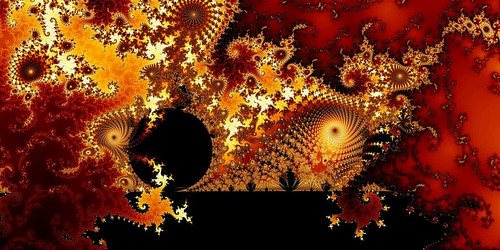
This apocalyptic view was created by combining six different fractal functions: two Mandelbrot sets, two Julia sets, and two Newton fractals. They were combined by interpolating between the six using a Bezier polynomial. The title is taken from an album by Earth, Wind & Fire.
The title works perfectly with the image and vice versa. On the left, you can see the fiery foreverness devouring the dark, exhausted world in the center whose passing of time has been punctuated by the telescoping trail of mandelbrot sihouettes. Tick, tick, tick… go the centuries. The consuming fires come from both ends. Our little world, growing dim now, has always existed between the twin spirals of past and future and now they’re going to meet like two curtains, drawing to a close, at the end of the age.
A nice little detail: the reverberating sun, pulsing like a solar heartbeat, can be seen just over the leftmost end of the mandelbrots. It too is changing, like the world it has illuminated all those years. “Immediately after the distress of those days “’the sun will be darkened, and the moon will not give its light; the stars will fall from the sky, and the heavenly bodies will be shaken. Then will appear the sign of the Son of Man in heaven. And then all the peoples of the earth will mourn when they see the Son of Man coming on the clouds of heaven, with power and great glory” Matthew 24:29-30
Yeah. This ain’t one of those pretty pinwheels off Deviant Art, man!
There’s more. At least, I see something more in there. Notice the movement of the fiery spirals from left to right, blending or colliding into the darker red, smooth, velvety background on the right. Both chaotic and random and yet powerful and permanent, the spirals are about to burn the shapes and stories of the world into that smooth eternity, final and forever.
I’m sure I could come up with many more things in there but there’s no need to word at it because the image speaks for itself. It doesn’t need any help from me. I don’t think you can miss the effect of this image, especially after seeing that well chosen title. Everything in the image just works so well. Which brings me to the fractal art thing. Fractals often have too much detail in them and it distracts from a central theme or message but Last Days and Time doesn’t suffer from that, which is one of the things that makes it unique.
That mandelbrot panorama, from the Big Beginning to the little end, time runs into the rollers at the end of the table and the final fire. Also, note how the self-similarity at various scales adds repetition as well as variety of size which falls perfectly in with the overall theme of The End but also The Time, the last days and the memory of all the days recorded in rows of rows.
What is art? In the words of Dzeni, a contributor from ages past, “This is art.” You can see the contemplation here I’m sure. If not in your own mind then at least in what’s been going on in mine. I said in a previous posting that Art is Contemplation. Fractals are very abstract, maybe even “too abstract” as Paul Lee once said on Fractalforums, even if they do exhibit to some degree a sort of naturalness and realism in their computerized forms (clouds and trees are fractal). It’s hard to make fractal art with a high degree of expressiveness because of this abstract factor without it becoming very limited in its audience like it is with the Rorschach test variety I posted about recently. Kerry has accomplished that with this image and that’s no small thing in the world of fractal art.