
Where was graphical AI back in 1999? Nowhere! that’s where. Terry Gintz on the other hand, was already there:
May 1999 — Added random fractal methods to Fractal Zplot 1.18.
June 1999 — completed Fractal ViZion — first version with automatic selection of variables/options for all fractal types.
-from the Fractal ViZion help file, Chronology.
Wait. He was even ahead of graphical AI because “automatic selection” of fractal parameters is the AI equivalent of a random prompt generator. Gintz’s random function makes you the captain of the starship Enterprise, sitting in your big chair on the bridge and all you have to do is push buttons on his “FV Remote” a floating window controller. Let’s take a look at this wonderful thing I have come to love and enjoy so much:

Yes, that’s a video recorder at the bottom. 1999 ought to be old, really old for fractal programs, but for me there’s still something cutting edge to Gintz’s programs like this (he made a lot of them). What is cutting edge about this? Random fractal image generation that works and is infinitely fun to work with at various scales.
All those numbers, 1-12 mean something different. It does common fractal types as well as L-systems, Quaternions, Strange Attractors and a few things I’m not sure of. Sometimes, as with the L-systems, the drawing can be even more interesting that what is finally rendered –ray traced, too.
I just push the buttons and watch it sort through formulas and then draw something:

Let’s start the Annual Fractal ViZion Random Renders Santa Claus parade:
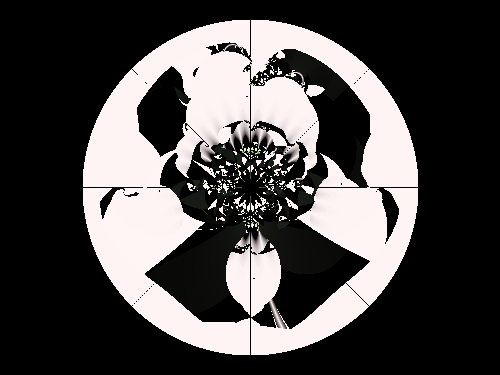
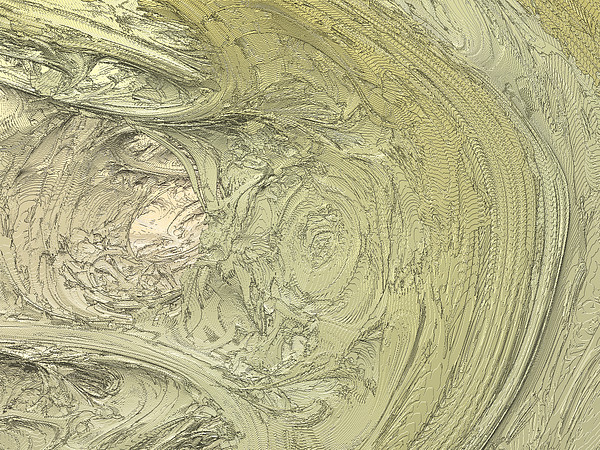
All of these images are totally random renders. I haven’t done anything to them except pushed a button on the remote and then save. Obviously I didn’t include everything that was randomly generated. Which brings us to an interesting point: is mere selection of an image from a whole lot of other ones, a creative artistic decision?
Which then quickly brings us to an interesting point about creativity and art: what on earth do you like about this?
Well, this (also quickly) brings us to an interesting concept in the study of art:
“Art as Rorschach Test: what you like tells us what’s wrong with you.”
Random fractals are the ultimate, real-time, Rorschach test. A Rorschach test being those inblot tests that often look like butterflies and were devised as a way to diagnose people’s mental state and condition by what they said they “saw” in the image. People’s minds would pick up on the little subtleties of the abstract inkblot and this would prompt “normal” people to describe normal imaginings while abnormal people would express other things in keeping, it was hoped, of their abnormal psychological state.
One famous artist, Marlene Dumas has stated that ‘All art is essentially a Rorschach test’. Meaning, the viewer’s mind projects meaning into the artwork rather than the artist expressing the meaning through the artwork. By meaning I think they mean, or I would describe it as, “response”. I use a word like that rather than meaning because almost all artwork works very quickly in our minds, it’s more of a response, a reaction, than an interpretation or something rational and thought out. Especially with abstract works which is what fractal formulas generally create. Think: reaction; sensation; response; sense; trigger; prompt; provoke.
What I find interesting about that black and white thing up there… Wait. How do we know what it is we really are thinking? And even if we did, aren’t the thoughts prompted by many kinds of images and imagery, artistic or just ordinary and common, aren’t they often rather hard to describe? Putting our thoughts into words is a real skill most of the time and especially in regard to things like art or whatever you want to call this sort of random image thing.
I think it’s enough to say that art is whatever makes us pause and consider a new and unexpected, but interesting thing. Art perhaps, is simply, anything of interest, in it’s minimal form and things of great, absorbing interest in its maximal form.
Back to the Fractal Rorschach parade:
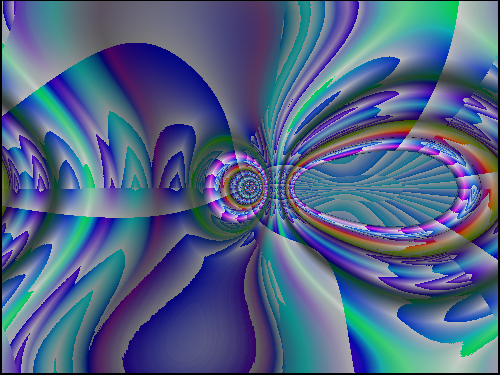
You will find this type of image quite often in 3d fractals: The Turning Passageway. By the way, as you may have noticed, these images aren’t even anti-aliased. I found it blurred things too much and the crisp jagged style had almost an anti-fractal art, retro look to it. Of course, the program is a little retro in some ways.
Note the common coloring to the eyeball thing and the opening portal; they go together, they fit together. On either side you see a passage going away to another place and with another shape and appearance. The more you think, the more you see, in random imagery.
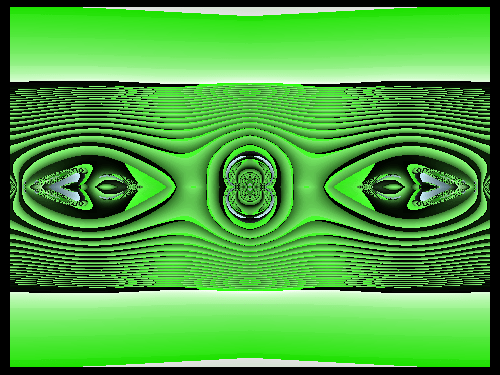
I don’t know where the black frame came from. Maybe Gintz thought of everything: even the frame! It does fit nicely. Framing art is another skill.
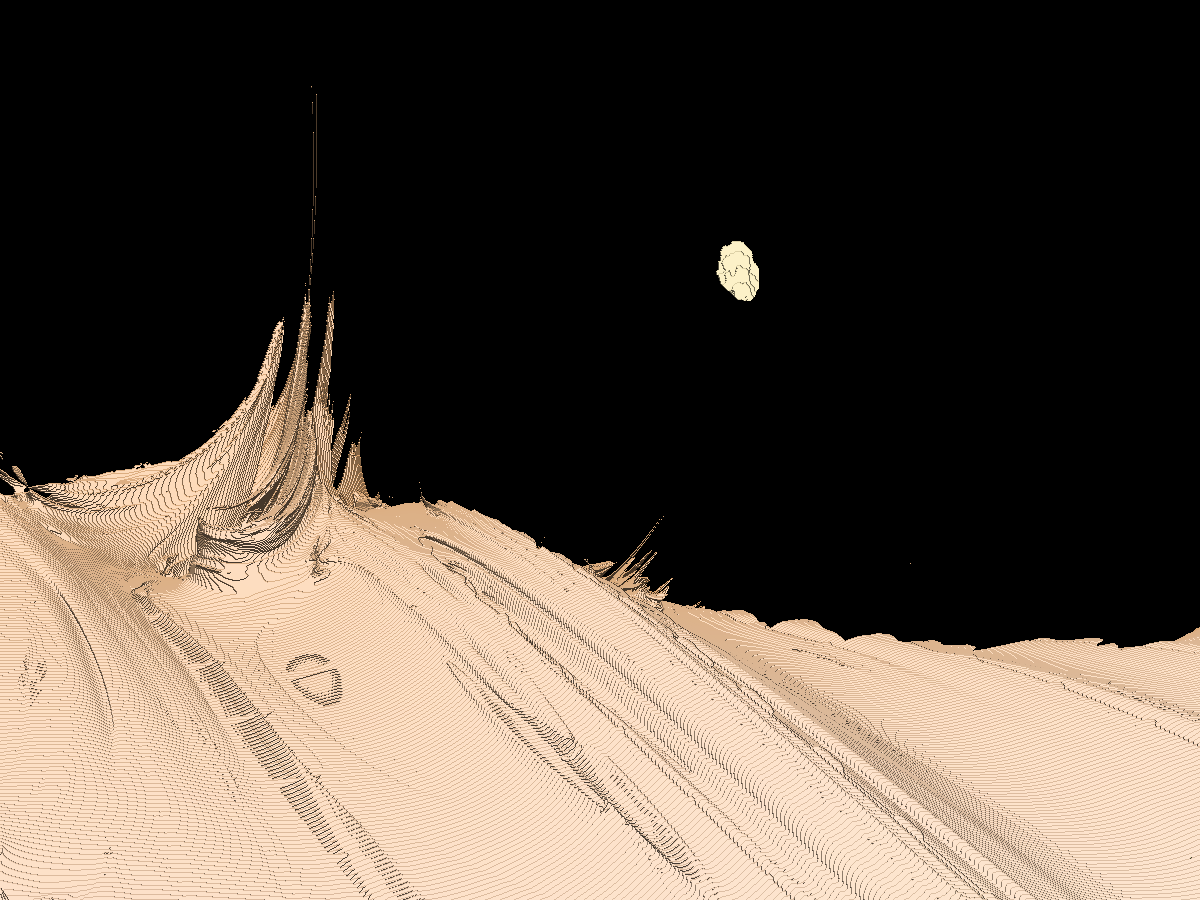
I think the most primitive and therefore perennial structure in visual imagery is the concept of a horizon. It suggests land below and sky above and gives an almost unavoidable and instant spatial orientation to the whole image. We then see three symbolic objects buried beneath the ground and a distant horizon and either evening or morning sky — beginning or ending. It suggests to me native myths and animistic traditions of the West. As I mentioned years ago, geometric and symmetrical structures are often used to illustrate religious concepts, which gives fractals a common “spiritual” interpretaton and use.
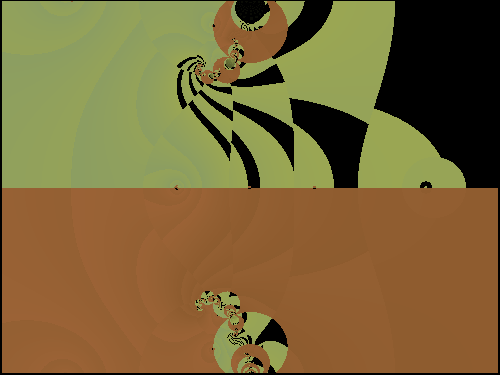
Another horizon-dominant image. The simplicity (flat, bleak) easily fits a panoramic, Western, interpretation. This time the fractal structure in the sky forming a huge cloud shape in the sky. Note the four little bumps on the horizon; houses? clumps of trees? a little town? or a big tractor? –or all four, in sequence? There is something suggestive of lostness in the little fractal thing in the foreground. It has turned away and given up its attempt to reach the horizon. Or is this just the way things are out here? Everything is just another little weed, blooming where it’s planted, it’s presence known only to those who are present with it. A big world of little worlds.
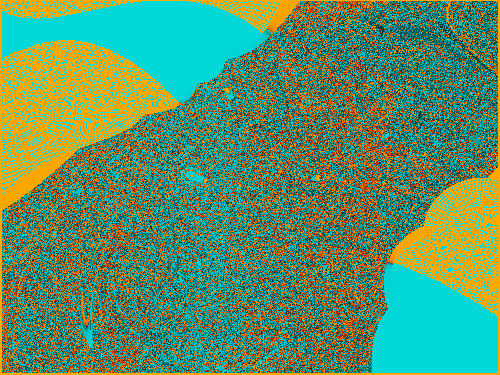
Mandelbrot said that when people look at fractals they often start to see things that are familiar because fractal structures are very common in nature. This reminds me of a Google Map satellite view of places in the Middle East, although the blue river is perhaps a little exaggerated for that locale. The banks of the river, if you look closely, are either orchards (olives?) or vineyards. But what is the big, dark mass in the middle and cutting across the whole image. I don’t know, but it looks like its been there for a long time. My guess is it’s just rough, rocky land that doesn’t have much use.
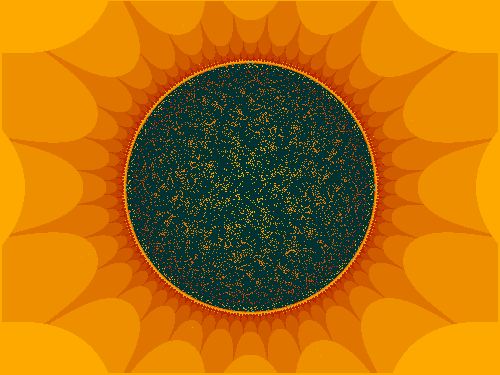 “The man who spoke to the Sun”
The Sun made itself cool so he could get himself close to the man.
I didn’t know the Sun could do things like that, the man said.
If you can believe it, no one has ever asked me anything before.
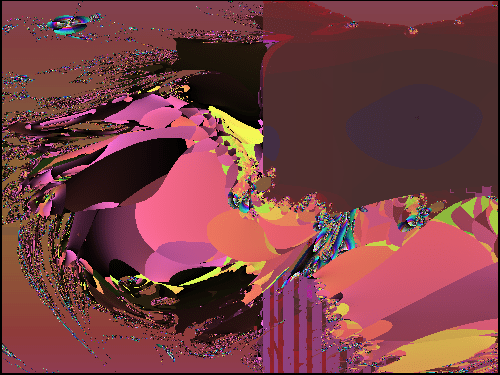
There is really no end to staring at fractal images, and the random ones have a kind of untamed wildness about them that, surprisingly, the human hand can only take away from rather than improve. Raw power, a raw visual power. They are computerized obviously and although best described as abstract, they have a familiar naturalness to them, as Mandelbrot remarked. They are places we’ve never been, but we can still look over the photos and plan our trip.
They are arbitrary and yet very creative and thoughtful –thought out. Sometimes I wonder if the best fractal art is actually the simplest and all the improving and efforts we make to “create art” just show how little we think of the viewer’s ability to appreciate fractal imagery as well as, come to think of it, how little we think of fractal imagery on its own –by it’s own– powers of expression.
Terry Gintz is the Einstein of fractal programming and fractal art, for that matter. Random rendering is a quantum leap over and beyond fractal art. It’s the closest thing there is to a really unique art form in fractal art. I predict people in the future will be more impressed with Fractal ViZion’s random generation feature than anything else the fractal world has done. Nothing else shows the real creative power in fractals like clicking on those buttons in the FV Remote.
I’d post a download link but they all seem to be dead.
Hi, I found a download link in a Dutch PDF file that actually worked :D
https://www.fractal.org/Interview-Jules-Ruis-over-Fractals.pdf
http://www.fractal.org/fractalimaginator64.zip
I’ve just installed it and it seems to work still in Windows 11.
Thanks for the link.
Also, those Acrylic Pours on your Deviant Art site are quite something, too.
My favourite (so far)…
https://www.deviantart.com/fractalsauce/art/Acrylic-Pour-20240404-1260468265