For those of you who took way too many math and science courses and have no idea what I’m talking about, here’s an example of an engraving:
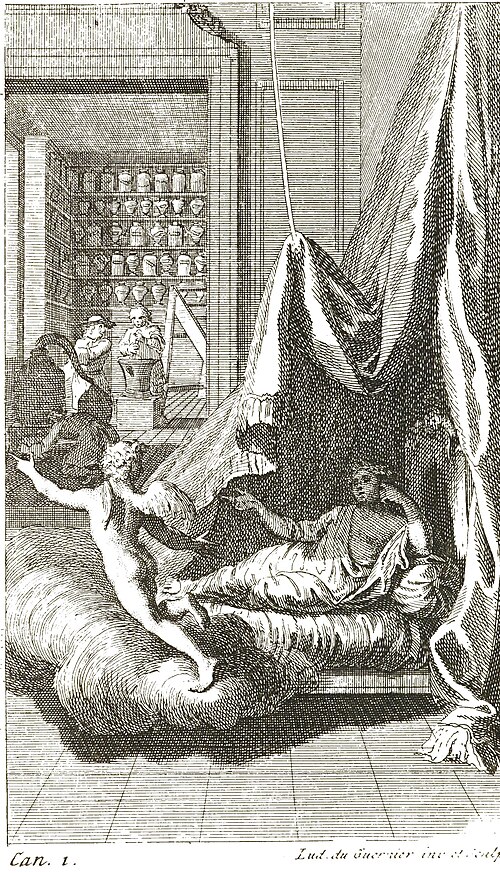
Engraved illustration from the Dispensary, Canto 1, 1714
An engraving is literally a picture drawn on the printing plate using a sharp, steel tool to etch the lines of the image into the plate. The ink is wiped onto the plate and stays in the scratchings while the untouched parts of the plate are wiped clean of the ink. The result, when the paper is pressed onto the plate, is the ink from the etchings is printed to the paper reproducing the picture the engraver engraved into the plate. If you took high school art classes like I did, you will know that this method is called intaligo. The image is composed then of etched lines and cross-hatched lines to add shadings. But it’s all lines. Nothing but lines.
Here’s another engraving to give you a better idea of the style of image that this process produces.
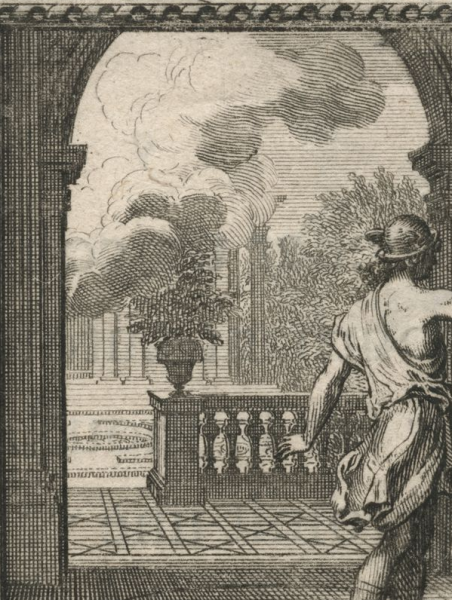
Engraving from Ovid’s Metamorphoses, 1676
Note the swirly lines on the clouds of smoke in the top of the image and the crosshatching technique to add shading at the bottom of the column of smoke. Again, it’s all lines, there are no solid areas of anything except for the blank, unengraved parts of the image.
Now, below, is an image made in Fractal Imaginator using one of it’s 3d formulas.
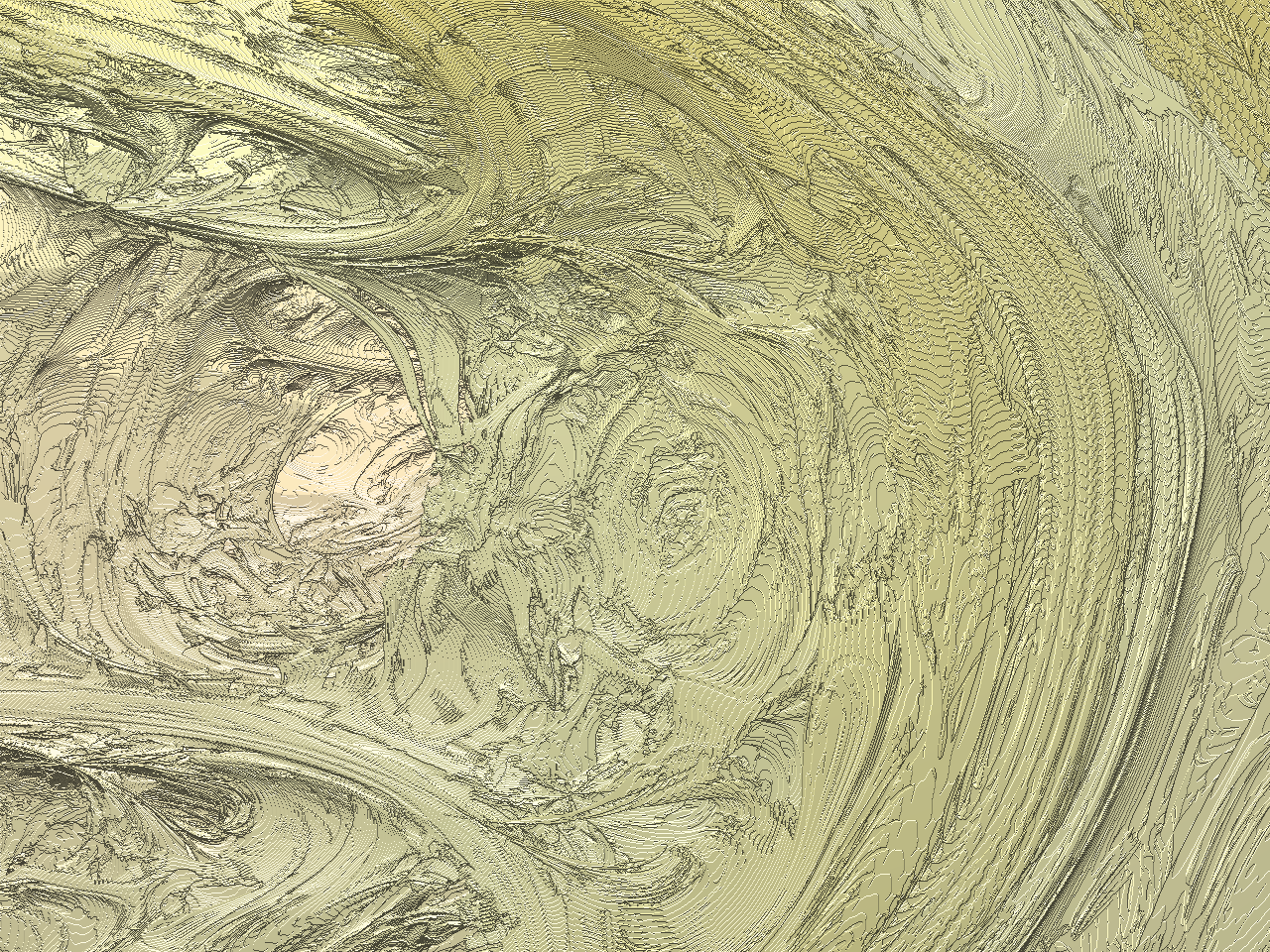
Lunarville01, made in Fractal Imaginator. Click to see a 4x larger version which is 100x more awesome.
Structurally, the image is really just a clay tunnel. Fractal Imaginator, released in several versions from 2006-2014 seems to be oriented towards producing 3d fractal images but occupies a stage of the 3d quest for the elusive 3d Mandelbrot that produced a number of semi-3d fractals. They tend to be characterized by what I think Daniel White called “whipped cream” structures which sort of fill in the blanks of the 3d data and was really not a fully 3d formula but a 3d tranformative technique for 2d formulas.
This is where the art in fractal art gets interesting. From my limited research and previous knowledge of Terry Gintz’s other programs like Fractal ViZion and Fractal Zplot, I think Fractal Imaginator being a collaborative project between Gintz and Jules Ruis, features Ruis’ unique 3d formulas but Gintz’s unique rendering techniques. In other words, Gintz’s rendering algorithms are what is responsible for turning what would otherwise be merely one step on the path to the development of 3d fractals into an engraver’s paradise. So fractal art is as much about rendering techniques as it is formulas. Otherwise, the awesome image above would be just a digital clay hole. Mathematically interesting perhaps but not so artistically appealing.
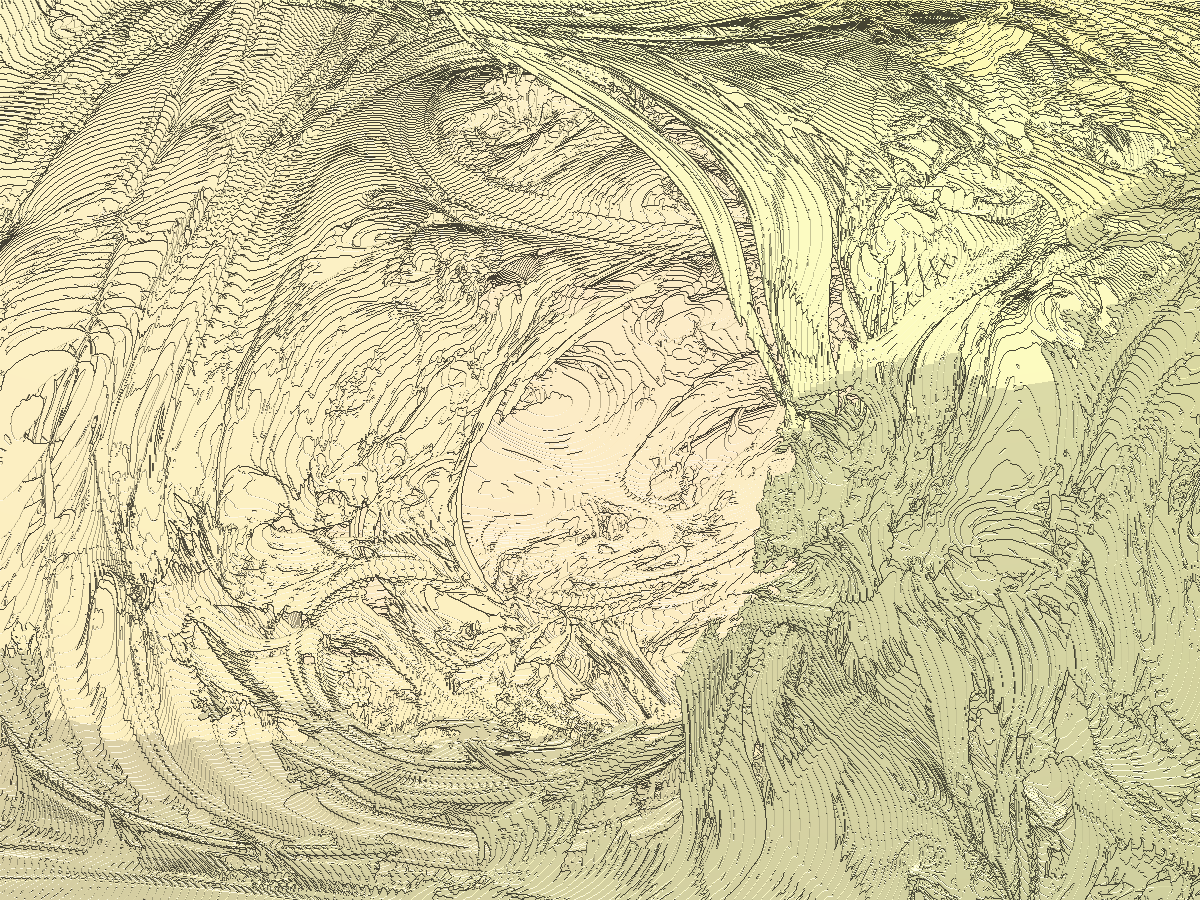
Lunarville02, made in Fractal Imaginator. Click to view large version.
If you’re sharp you’ll notice that this is a zoomed in detail area of the first image, Lunarville01. I’ve included it because of the interesting area in the middle, the light colored area which is the deeper part of the humble clay hole. Here, the rendering technique starts to drift from a simple engraved appearance to the short, incomplete lines of a simple line drawn picture. This is equally interesting I find as the engraved effect.
But now, The Symphony of Skeletons:
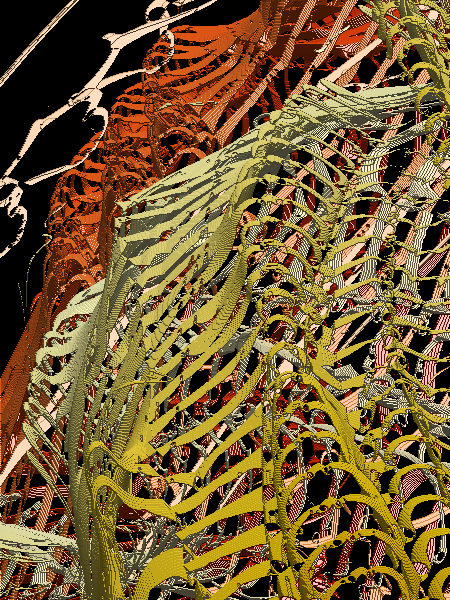
Cablegram08
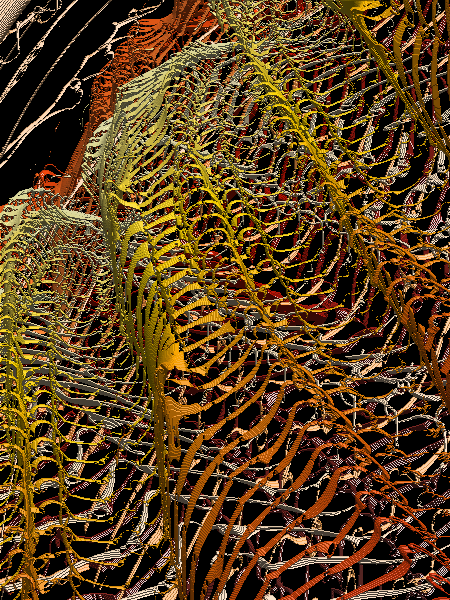
Cablegram07
The same rendering technique that produced the engraved look and the line drawn look has here produced a 1970s horror comicbook look. Trust me. I read a lot of horror comicbooks and unlike most of my favorite comic books which date from the late 50s and early 60s, the artwork in horror titles actually took a quantum leap upward (instead of downward) in the (early) 70s.
Here is a fine example of that more free-flowing, artsy, organic style that characterizes many of the horror comics of the 70s (but not the superhero titles).
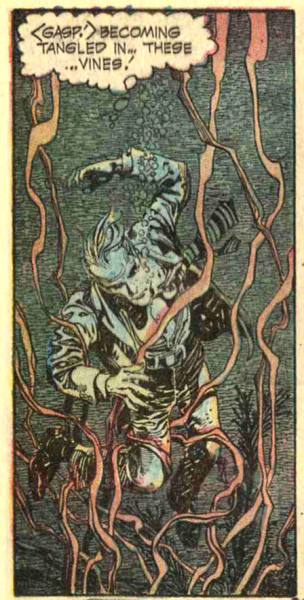
House of Mystery #219 from November, 1973
Far out, eh? Nothing hits a fractal formula out of the ball park like a cool rendering method. A rendering method is so influential because it can be applied to any formula. My way of using a fractal program in fact, is to find some image style that looks good and then experiment with it by applying it to other formulas. In this case with Fractal Imaginator, the image style is not a single rendering option from the menu items but is the main, general rendering style for the whole program, at least for the 3d formulas. It might actually be an artifact of the ray-tracing feature and how the 3d “substance” is built. 3d images seem to be build of strips and layers of material which when combined with the sharp ray-tracing effect highlights this strip and layered texture to the 3d objects.
Here’s another, slightly different incarnation of the rendering style of Fractal Imaginator. I find this to be reminiscent of watercolor paintings or a hand-tinted engraving. Engravings produced as framable wall art back in the old days prior to the 20th century were often hand painted, quick and by the 100s I imagine.
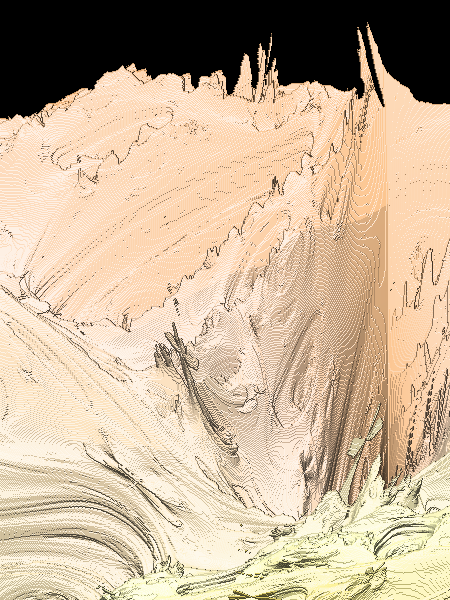
Lunarland01, made in Fractal Imaginator. The watercolor look.
This leads into my next posting which is going to be about the Sci-fi paintings of Chesley Bonestell and how some of the imagery from Fractal Imaginator fits right into his classic rugged lunarscape style which he popularized and came to be the standard look for alien planets and unknown worlds.
I almost forgot. Many thanks to the recent commentor here on Orbittrap, FractalSauce who actually introduced me to the program by the link he posted. Never before has a comment on OT ever been so helpful! I have a lot of Terry Gintz’s programs but I didn’t actually have that one. It was a totally new find to me. I highly recommend FractalSauce’s Deviant art gallery, especially his poured paint paintings. Better than Pollock!
Here is a link to the parameter files for the five Fractal Imaginator images in this post: fi6_files.zip.
To use them, just go to File/Load Other/Load Parameters… Here is FractalSauce’s original link to download Fractal Imaginator. The program is free thanks to the kind generosity of Terry Gintz and Jules Ruis! True fractal heroes.